Pearson Independence 20

Pearson Yachts

Pearson Independence 20 is a 20.5 ft sloop sailboat built by Pearson Yachts and designed by Gary Mull, first produced in 1986. It has displacement of 2,080 lb, a hull speed of 5.65 kt and a fin keel.
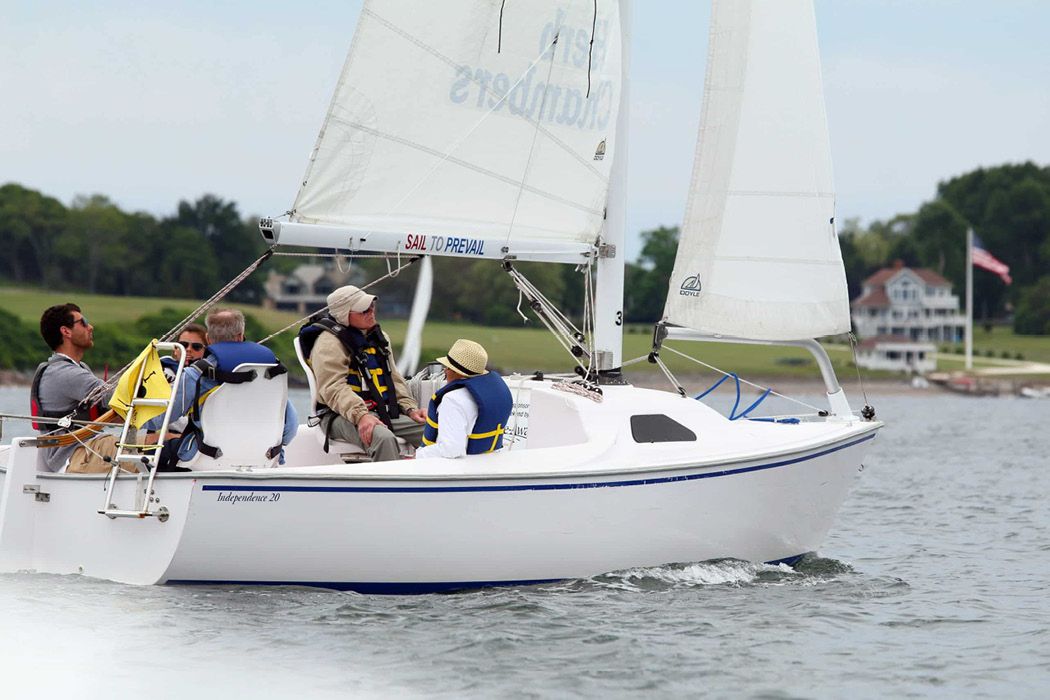
Pearson Independence 20
AbleSail Network · Photo source
Community photos are ranked by votes.Add your photo

At a glance

Length
20.5 ft↗
Beam
8 ft↗
Draft
4 ft
Displacement
2,080 lb↗
Ballast
900 lb↗
Rig
Sloop
Built
1986↗
Hull speed
5.65 kt

The quick verdict

The Independence 20 is particularly well suited to adaptive sailors, sailing schools and anyone seeking a stable, accessible daysailer. Its counterweighted seating, self-tending jib and unstayed rig distinguish it from conventional small keelboats. Its main limitation is its emphasis on cockpit space rather than cruising accommodations. Few conventional used-boat reviews exist, making inspection of its specialized equipment especially important.

Standardized sailing characteristics

Speed

PHRF 240

Lower PHRF means a faster racing handicap. Rig, keel, and region affect ratings.

Reference source ↗

Comfort at Sea

Catalina 22 Mk IIPrecision 28Oceanis 37Catalina 30Island Packet 38Oyster 53
10.84

This boat's motion comfort ratio: a comparison of how gently a design moves at sea. A higher number is gentler. It does not rate cabin space or guarantee comfort.

Capsize screening (CSF)

Catalina 22 Mk IIPrecision 28Oceanis 37Catalina 30Island Packet 38Oyster 53
CSF 2.51

The Capsize Screening Formula: beam compared with displacement. A lower number means a boat is less prone to capsize, so the scale runs from least to most capable offshore; 2.0 or below is the usual guide. It is a screening figure, not a safety guarantee.

Shopping for a boat like this?

Tell us how you'll sail and who's coming along. The Boat Picker asks a few quick questions and shows which boats fit your plans, so you can skip the guesswork.

Try the Boat Picker

Measurements

Rig diagram & sailing measurements

Rig dimension reference
Rig measurement diagram showing I, ISP, J, P, E, PY and EY
General rig reference. PY and EY apply to boats with a mizzen mast.
CSF2.51
Above 2.0: generally does not meet the traditional offshore screening guideline (not a seaworthiness rating).
Rig dimension I (foretriangle height)20.5 ft↗
Rig dimension J (foretriangle base)7 ft↗
Rig dimension P (mainsail luff)25.2 ft↗
Rig dimension E (mainsail foot)9.2 ft↗
Forestay length21.66 ft
Sail area (base / working)230 sq ft↗
Mainsail area115.9 sq ft
Spinnaker / gennaker area220 sq ft↗
Ballast / displacement ratio43.3
Hull speed5.65 kt

All specifications

Production years
1986↗
Designer
Gary Mull↗

Dimensions & rating

Length overall
20.5 ft↗
Beam
8 ft↗
PHRF
240↗
Displacement
2,080 lb↗
Hull speed
5.65 kt
Draft
4 ft
Keel type
Fin↗
Rudder type
Transom-hung↗
Twin wheels
Missing
Rig type
Sloop
Mast step
Missing

Construction

Construction

Hull material
Fiberglass ↗
Hull cored below waterline
No
Keel type
Fin ↗
Keel material
Lead ↗
Rudder type
Transom-hung ↗
Number of rudders
1

Full specifications

Figures link to the page they came from where one is published. Anything not shown is not yet confirmed by a published source.

Identity

Designer
First year built
1986 lfyc.net ↗
Preferred historical date. Good Old Boat dates the design to 1985, and a firsthand account confirms sailing the boat in 1987. Conflicting database figure: 1999.
Country built
United States en.wikipedia.org ↗
Initially built by Tillotson Pearson for Freedom Yachts, followed by Catalina Yachts.
Boat type
Sailing monohull sailcentral.com ↗
Adaptive sailing and training keelboat.
Hull type
Monohull

Hull measurements

Length overall
20.5 ft immediac.blob.core.windows.net ↗
Ontario Sailing uses the equivalent Freedom Independence model name.
Waterline length
17.75 ft
Reference database figure corroborated by Wikipedia.
Draft (standard keel)
4 ft
Fixed fin keel. Ontario Sailing publishes a shallower measurement, but no separate keel option has been confirmed. Fixed fin keel: 3.75.
Hull speed
5.65 kt
Calculated: 1.34 x the square root of the waterline length (17.75 ft).
Displacement (light / design)
2,080 lb immediac.blob.core.windows.net ↗
Published design displacement.
Ballast weight
900 lb cpfamilynetwork.org ↗
Other published figure: 800.
Ballast material
Lead northernyachtclub.ca ↗
Reported by an adaptive sailing program operating this design.
Ballast / displacement ratio
43.3
Calculated: ballast divided by displacement, using the published figures on this page.

Rig and sails

Rig type
Sloop
Unstayed fractional sloop with a self-tending jib.
Number of masts
1 lfyc.net ↗
Single-masted fractional sloop.
Sail area (base / working)
230 sq ft immediac.blob.core.windows.net ↗
Published total sail area.
Rig dimension I (foretriangle height)
20.5 ft fxsails.com ↗
Sailmaker's model-specific rig database. No independently published second measurement located.
Rig dimension J (foretriangle base)
7 ft fxsails.com ↗
Sailmaker's model-specific rig database.
Rig dimension P (mainsail luff)
25.2 ft fxsails.com ↗
Sailmaker's model-specific rig database.
Rig dimension E (mainsail foot)
9.2 ft fxsails.com ↗
Sailmaker's model-specific rig database.
Forestay length
21.66 ft
Calculated: the square root of (I squared + J squared), using the published rig dimensions on this page.
Mainsail area
115.9 sq ft
Calculated: half of P x E (25.2 x 9.2 ft), using the published rig dimensions on this page.
Spinnaker / gennaker area
220 sq ft fxsails.com ↗
Largest replacement spinnaker area published by FX Sails. Asymmetrical and tri-radial products are offered, but the supplier does not identify which configuration corresponds to 220 square feet. Not confirmed as original factory equipment.
Displacement / Length ratio
166.0
Calculated: (displacement in long tons) divided by (0.01 x waterline length) cubed, using the published figures on this page.
Capsize screening value
2.51
Calculated: beam divided by the cube root of (displacement in lb / 64), using the published beam and displacement on this page.
Motion comfort ratio (Brewer)
10.84
Calculated with Brewer's formula from this page's displacement, waterline length, overall length and beam.

Practical ownership

Strengths (sourced)
Stable hull, accessible cockpit and adaptable seating nolacommunitysailing.org ↗
Designed for inclusive sailing, instruction and sailors with limited mobility.

Calculated from the figures above

Sail area / displacement ratio
22.58
Calculated: sail area divided by (displacement in lb / 64) to the power 2/3, using the published sail area and displacement above.
Pounds per inch of immersion (estimate)
507.4
Estimated, not measured: waterline length x beam x 0.67 (typical waterplane coefficient) x 64 / 12, using the published figures above.

Pearson Independence 20 problems

Reported by owners and reviewers. Condition varies from boat to boat.

  • Community Sailing New Orleans operates Independence 20s as stable training platforms with adaptive equipment for sailors of different abilities. ↗
  • Northern Yacht Club reports that the weighted adaptive seats pivot across the cockpit as the boat changes direction. ↗
  • Lake Forest Yacht Club identifies cockpit drainage, flotation and simplified sail handling among the design's useful training features. ↗

What the magazines say

Owner experiences and professional commentary are separate sources. Condition varies from boat to boat.

  • Practical Sailor described a newly built Catalina Independence 20 as a particularly robust sloop intended for adaptive sailing. Read source
  • Canadian Boating highlights the unstayed mast system as a way to reduce standing rigging complications during adaptive sailing. Read source
  • Good Old Boat describes the Independence 20 as a purpose-designed adaptive keelboat with a spacious cockpit and secure seating arrangements. Read source

What's on file

Nothing from owners yet. If you own one, you can add a survey or receipts in My boats and help the next buyer.

Surveys and Market Value

No surveys have been contributed for this boat yet.

Community

Sign in

Be the first to comment.