THE BOAT WIKI by Lady K

Catalina 42

Catalina Yachts
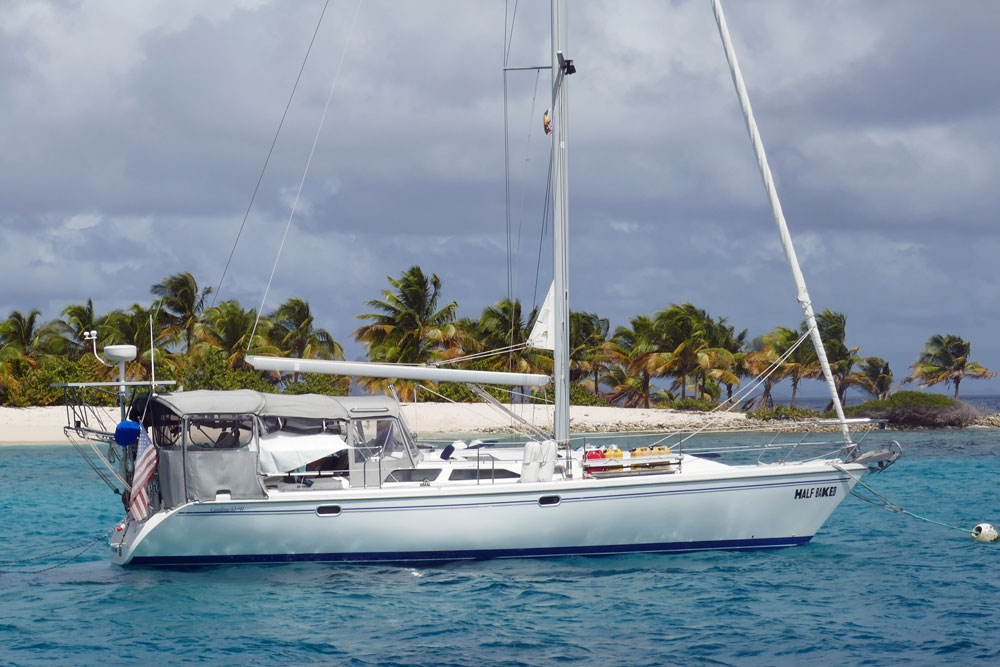
Catalina 42
Sailboat-Cruising.com · Photo sourceAdd your photo
Production years
1989–2011
Designer
Gerry Douglas / Catalina Yachts↗

Dimensions & rating

Length overall
41.83 ft↗
Beam
13.83 ft↗
Displacement
Mk I: 18,000 lb | Mk II: 20,500 lb↗↗
Draft
Mk I: 6 ft↗
Keel type
Fin↗
Rudder type
Spade↗
Twin wheels
No↗
Rig type
Sloop↗
Mast step
Keel-stepped↗

The quick verdict

The Catalina 42 is an appealing choice for family cruisers, liveaboards and sailors who want respectable sailing performance without sacrificing accommodation space. Its strengths are its roomy interior, solid fiberglass hull and generally straightforward systems. Its compromises include limited handholds, some awkward galley arrangements and production-boat equipment choices. Inspect the rudder, deck core, keel bolts, rigging, structural liner and blister history carefully, particularly on earlier examples.

Should I buy this boat? →

Find out whether this design suits your sailing plans with The Boat Picker.

Measurements

Figures here are for the Mk I (standard version). Use the version buttons at the top to see the others.

Rig diagram & sailing measurements
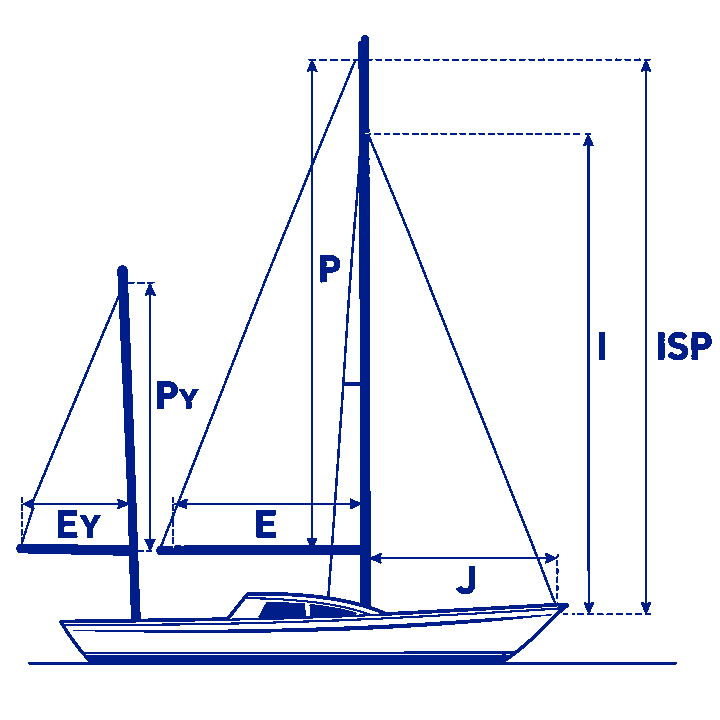
Rig dimension reference
Rig measurement diagram showing I, ISP, J, P, E, PY and EY
General rig reference. PY and EY apply to boats with a mizzen mast.
CSF2.02
Above 2.0: generally does not meet the traditional offshore screening guideline (not a seaworthiness rating).

Production history

Mk I

1989–1995
  • Early boats had a 4 ft 10 in wing keel; later boats switched to a 6 ft fin keel
  • Short rudder, one of the main things the Mk II changed

Mk II

1995–2011
  • New rounded, contemporary stern with a fuller section aft
  • Cockpit gained a 48-inch drop-leaf table and corner seats
  • Removable transom seat replaced the stern-rail cutout
  • Deeper, high-aspect, semi-elliptical spade rudder
  • Winches upgraded to Lewmar 42s

Full specifications

Every figure links to the page it came from. Anything not shown is not yet confirmed by a published source.

Identity

Designer
Gerry Douglas / Catalina Yachts spinsheet.com ↗
The Catalina production design was developed in-house. Its hull originated from an earlier Nelson/Marek racing design.
Lineage note
Original Catalina 42 derived from a Nelson/Marek racing hull; Gerry Douglas developed the production cruiser. Mk II retained the basic design while revising its stern, cockpit, interior options and rudder. sailboat-cruising.com ↗
SpinSheet and Practical Sailor independently confirm the 1995 redesign and its principal changes.
First year built
Last year built
Number built
Mk I: 477 sailingmagazine.net ↗
Also confirmed by SpinSheet and Practical Sailor. Mk II production exceeded the approximately 300 units recorded in some older databases, but an exact final Mk II total was not established.
Country built
United States sailboat-cruising.com ↗
The page identifies the builder as Catalina Yachts (USA); contemporary reviews describe the builder's Southern California operations.
Hull type
Monohull boat-specs.com ↗
Conventional fiberglass sailing monohull.

Hull measurements

Length overall
41.83 ft spinsheet.com ↗
Hull length. Catalina's 2005 brochure lists "Length Overall" as 43 ft 2 in, which adds the bow pulpit and swim platform; the hull is 41 ft 10 in.
Length on deck
41.83 ft catalinayachts.com ↗
Builder's Length of Hull, distinguished from its larger Length Overall specification.
Waterline length
Beam (widest)
13.83 ft catalinayachts.com ↗
Also confirmed by SpinSheet and SAILING Magazine.
Draft (standard keel)
Mk I: 6 ft spinsheet.com ↗
Original published fin-keel specification. Practical Sailor also identifies the earlier 6-foot fin keel.
Draft (alternate keel 1: shoal / wing / centerboard up)
4.83 ft catalinayachts.com ↗
Optional shoal-draft wing keel. Same published dimension in the earlier design.
Air draft (clearance height)
Mk II: 58.58 ft catalinayachts.com ↗
Builder's waterline-to-masthead measurement. Does not necessarily include antennas or other masthead equipment; do not use as guaranteed bridge clearance.
Displacement (light / design)
Mk I: 18,000 lb sailingmagazine.net ↗
Original published design estimate, subsequently acknowledged as optimistic. SpinSheet suggests actual displacement of both versions can approach 22,500 pounds.
Mk II: 20,500 lb catalinayachts.com ↗
Builder's approximate basic weight for both fin- and wing-keel configurations.
Ballast weight
8,300 lb catalinayachts.com ↗
Builder specifies the same ballast weight for both keel configurations. Practical Sailor independently confirms this figure.
Ballast material
Trailerable
No boat-specs.com ↗
The specification explicitly gives No for Trailerable. This is a large, fixed-keel cruising sailboat.

Construction

Hull material
Fiberglass practical-sailor.com ↗
Solid fiberglass laminate, rather than a conventional sandwich-cored hull.
Hull cored below waterline
No spinsheet.com ↗
Solid fiberglass hull laminate.
Hull cored above waterline
No spinsheet.com ↗
Practical Sailor describes Coremat within portions of the upper hull laminate; this is not equivalent to a conventional balsa- or foam-sandwich hull.
Hull core material
None; solid fiberglass laminate spinsheet.com ↗
Deck cored
Deck core material
Balsa practical-sailor.com ↗
Half-inch marine plywood replaces balsa in areas supporting deck hardware.
Hull-to-deck joint
Outward flange practical-sailor.com ↗
Practical Sailor describes a bonded external flange through-bolted at eight-inch intervals.
Structural grid / pan liner
Bonded molded fiberglass structural pan incorporating cabin sole, furniture and berth foundations practical-sailor.com ↗
The liner is secondarily bonded to the hull; inspect for separation or movement, particularly forward.
Keel type
Fin catalinayachts.com ↗
Deep-fin configuration; optional shoal-draft wing keel also available. Another source gives Wing (sailingmagazine.net: Alternative fixed shoal-draft keel, not a centerboard.).
Keel material
Lead billdietrich.me ↗
Reproduced correspondence attributed to Catalina Yachts. SAILING Magazine independently confirms lead ballast.
Keel attachment
Bolted tapatalk.com ↗
Owners' association technical discussion confirms external keel bolts and discusses manufacturer-supplied torque information. Source could not be opened by the site (blocked, a picture of a brochure, or a very large file); the quote was supplied by ChatGPT and could not be machine-checked.
Rudder type
Spade sailboat-cruising.com ↗
A separate horizontal skeg extends aft from the keel but does not carry the rudder. The Mk II introduced a deeper, higher-aspect, semi-elliptical rudder.
Number of rudders
1 boat-specs.com ↗
Both marks use one rudder. The Mk II introduced a deeper, more elliptical rudder.
Twin wheels
No sailingmagazine.net ↗
The Catalina 42 has a single pedestal-mounted steering wheel.
Steering type
Wheel practical-sailor.com ↗
Single-wheel Edson pedestal steering.
Fuel tank material
Aluminium catalinadirect.com ↗
Catalina Direct supplies original-pattern aluminum replacement tanks and reports thinner aluminum in early factory installations. Source could not be opened by the site (blocked, a picture of a brochure, or a very large file); the quote was supplied by ChatGPT and could not be machine-checked.
Fresh water tank material
Plastic practical-sailor.com ↗
Material described by Practical Sailor; number and position of tanks can vary by layout and production year.
Holding tank material

Rig and sails

Rig type
Sloop sailingmagazine.net ↗
Masthead sloop with double swept-back spreaders.
Rig options offered
Mk II: Standard full-batten mainsail; optional in-mast or in-boom furling catalinayachts.com ↗
Sail-handling options, not separate production marks.
Mast material
Aluminium tapatalk.com ↗
An owner identifying as a rigger describes the C42 mast as aluminum. Practical Sailor identifies the earlier anodized Isomat NG80 spar. Source could not be opened by the site (blocked, a picture of a brochure, or a very large file); the quote was supplied by ChatGPT and could not be machine-checked.
Mast stepping
Keel-stepped catalinadirect.com ↗
Supported by Catalina Direct's Catalina 42-specific mast-collar equipment. Source could not be opened by the site (blocked, a picture of a brochure, or a very large file); the quote was supplied by ChatGPT and could not be machine-checked.
Sail area (base / working)
797 sq ft catalinayachts.com ↗
Builder-stated mainsail plus 100% foretriangle area. Also confirmed independently by Practical Sailor.
Rig dimension I (foretriangle height)
Rig dimension J (foretriangle base)
16.42 ft catalinayachts.com ↗
Rounded decimal equivalent of the builder's measurement.
Rig dimension P (mainsail luff)
Rig dimension E (mainsail foot)
Spinnaker / gennaker area
1,324 sq ft goodoldboat.com ↗
Symmetrical spinnaker listed in Good Old Boat's Saildata database, with 180% LP. The page marks the figure as algorithm-calculated. Its listed asymmetrical sail is 1144 square feet. Neither figure is
Mainsail area
362 sq ft catalinayachts.com ↗
Builder-rated mainsail area.
Headsail / genoa area
649.17 sq ft goodoldboat.com ↗
150% LP genoa in Good Old Boat's Saildata database. The page marks this area as algorithm-calculated, rather than builder-rated. It also lists a smaller 135.2% genoa of 566.08 square feet.
Capsize screening value
Motion comfort ratio (Brewer)

Ratings and safety

STIX number
39.86 tapatalk.com ↗
Corrected Catalina 42 figure reported by a Catalina 4 Series Association participant following contact with Windward Yachting, the UK Catalina distributor. Earlier Yachting Monthly and RYA information Source could not be opened by the site (blocked, a picture of a brochure, or a very large file); th
Angle of vanishing stability
114.3° tapatalk.com ↗
Corrected Catalina 42 angle of vanishing stability supplied by the UK Catalina distributor and reported in the owners' association forum. Earlier published figures around 104 to 105 degrees were repor Source could not be opened by the site (blocked, a picture of a brochure, or a very large file); th

Engine, propulsion, systems

Original engine make
Yanmar sailingmagazine.net ↗
Several factory engine models and power ratings were fitted during production.
Original engine model
Mk I: Yanmar 4JHBE practical-sailor.com ↗
Documented earlier four-cylinder diesel. Another source gives Yanmar 4JHTE (sailingmagazine.net: SAILING Magazine identifies this as standard after 1991.).
Mk II: Yanmar 4JH4BE catalinayachts.com ↗
Engine model specified in the builder's 2005 brochure. Another source gives Yanmar 4JH2E (www.practical-sailor.com: Older published Mk II specification reproduced by Practical Sailor; model varied over the production run.).
Fuel capacity
Mk I: 39 gal sailingmagazine.net ↗
Conflicting published specification. Catalina Direct's original-tank documentation supports 34 gallons as the actual early production capacity. Another source gives 34 (www.catalinadirect.com: Catalina Direct reports that the actual original production tank held 34 gallons, despite higher figures ap
Mk II: 46 gal catalinayachts.com ↗
Later standard tank. Catalina Direct dates the larger tank to 1999, beginning with hull 683. The builder also offered an additional 17-gallon fuel tank. Another source gives 34 (www.catalinadirect.com: Early Mk II production before the 1999 fuel-tank enlargement. Source could not be opened by the si
Original engine power
Mk I: 44 hp sailingmagazine.net ↗
Original engine before 1991.
Mk II: 54 hp catalinayachts.com ↗
Builder's 2005 specification. Another source gives 50 (www.practical-sailor.com: Older published Mk II specification, corresponding to the 4JH2E.).
Fresh water capacity
Mk II: 111 gal catalinayachts.com ↗
2005 builder brochure, two-cabin layout. Owners' association calculations report 115 gallons for some post-1991 two-cabin boats.
Holding tank capacity
Mk II: 30 gal catalinayachts.com ↗
Forward holding tank; the builder specifies a separate aft tank.

Accommodation

Cabins
2 catalinayachts.com ↗
Two-cabin interior option; forward owners' accommodation plus one aft cabin.
Heads (count, enclosed or not)
2 catalinayachts.com ↗
Forward and aft heads; also documented by SAILING Magazine.
Navigation station
Yes sailingmagazine.net ↗
Location and size vary with the two- versus three-cabin layout.

Practical ownership

Known issues (sourced to magazines / associations)
Inspect for osmotic blistering, deck-core moisture, rubrail damage, rudder-bearing wear, structural-liner debonding, aging chainplates and standing rigging, and deteriorating plumbing. Earlier short rudders can produce heavier helm loads. sailingmagazine.net ↗
SAILING Magazine identifies rudder bearings, blistering, liner bonding, rigging, chainplates, hoses and through-hulls as inspection priorities. Practical Sailor also reports blister cases and the rudd
Strengths (sourced)
Spacious accommodations, sound fiberglass construction, respectable sailing performance, good engine access, large cockpit, accessible side decks and strong used-boat value. spinsheet.com ↗
Practical Sailor and SAILING Magazine independently describe its successful cruising layout and performance.
Owners' association link
Https://www.tapatalk.com/groups/catalina42discussionforum/ tapatalk.com ↗
Catalina 4 Series Association discussion forum; the association also maintains resources at catalina4series.org. Source could not be opened by the site (blocked, a picture of a brochure, or a very large file); the quote was supplied by ChatGPT and could not be machine-checked.

Calculated from the figures above

Pounds per inch of immersion (estimate)
1779.1
Estimated, not measured: waterline length x beam x 0.67 (typical waterplane coefficient) x 64 / 12, using the published figures above.

Surveys and Market Value

No surveys have been contributed for this boat yet.

When owners contribute surveys, we plan to share anonymized recurring issues and used-boat value ranges, helping future buyers know what to inspect and what similar boats are worth. Survey uploads are coming soon.

Coming soon
Your privacy matters.

We plan to remove names, contact details, precise locations and vessel identifiers before sharing aggregated findings and value ranges. Individual survey documents will not be published.

Community contributions or corrections

Do you have information about this boat, a photo of it, or advice for future owners? Leave a comment below regarding this make and model. For corrections, leave the corrected information with the source so we can investigate and update the boat wiki page.

Sign in

Comments

No comments yet.