THE BOAT WIKI by Lady K

Catalina 22

Catalina Yachts

Catalina 22
Ahunt · CC0 1.0 · Photo sourceAdd your photo
Production years
1969–1994
Total built
15,000+
Designer
Frank Butler

Dimensions & rating

LOA
21' 6"
Beam
7' 8"
PHRF
276↗
Displacement
2,250 lb
Headroom
4′4″ (closed) | 5′7″ (pop-top raised)↗
Draft by configuration↗
Swing2' (raised) / 5' (lowered)
Fixed fin3' 6"
Wing2' 6"
Rudder type
Transom-hung↗↗
Rig type
Masthead sloop↗
Mast step
Deck-stepped↗

The quick verdict

An approachable trailerable pocket cruiser and club racer with a large owner support network. The original Catalina 22 is well suited to lakes, protected coastal waters and weekend sailing; it is not a dedicated offshore passagemaker.

Why people like it: Easy trailering and simple outboard operation, available parts and a large owners community provide an accessible introduction to sailing.

Before buying: Check swing-keel cable, pivot, winch, keel trunk, bulkhead/chainplate leaks, rigging, sails and trailer condition before purchase.

Should I buy this boat? →

Find out whether this design suits your sailing plans with The Boat Picker.

Standardized sailing characteristics

Speed

PHRF 276

Lower PHRF means a faster racing handicap. Rig, keel, and region affect ratings.

Reference source ↗

Comfort at Sea

11.54

Raw Brewer Motion Comfort Ratio, a comparison of design motion at sea. It does not rate cabin space or guarantee comfort.

Measurements

Figures here are for the Original 1969–1985 (standard version). Use the version buttons at the top to see the others.

Rig diagram & sailing measurements
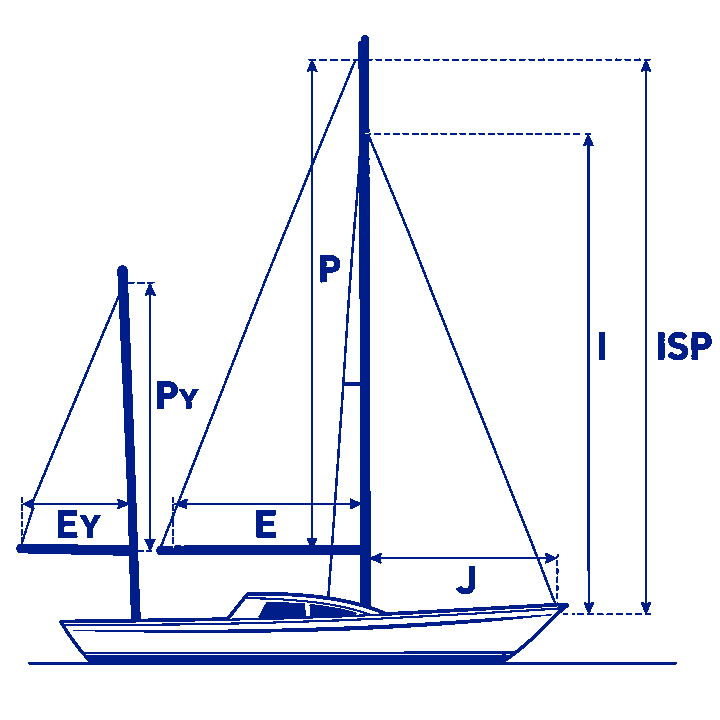
Rig dimension reference
Rig measurement diagram showing I, ISP, J, P, E, PY and EY
General rig reference. PY and EY apply to boats with a mizzen mast.
SA/D · SAIL AREA TO DISPLACEMENT19.09
Below 16 is considered conservative sail power, 16–20 moderate sail power, and above 20 high sail power.
D/L · DISPLACEMENT TO LENGTH139
S-NUMBER3.84
Calculated from SA/D and D/L (Brewer)
CSF2.34
Above 2.0: generally does not meet the traditional offshore screening guideline (not a seaworthiness rating).
Waterline length19' 4"
Ballast550 lb
Working sail area205 ft²↗
Air draft29' 1"
Foretriangle area103.32 ft² ↗
Mainsail triangle101.54 ft² ↗
Estimated forestay (published standard rig)27.04 ft ↗

Rig dimensions by configuration

Published model referenceIJPE100% triangular sail area
Published rig25′10″8′21′9′8″204.9 ft²

100% triangular sail area = (I × J + P × E) / 2. Source ↗

Construction & Equipment

Hull & Deck

Hull below waterline
Solid fiberglass (uncored) ↗
Hull above waterline
Solid fiberglass (uncored) ↗
Deck construction
Fiberglass sandwich laminate ↗
Deck core
Plywood ↗
Hull-to-deck joint
mechanically fastened ↗

Rig & Steering

Sail plan
Masthead sloop ↗
Steering
tiller↗
Rudder count
1 ↗
Rudder type
Transom-hung rudder ↗
Helm stations
1 ↗

Tankage

Portable container · Freshwater
5 US gal ↗
Early factory manual

Accommodation

Advertised berths
5 ↗
Published maximum headroom
4′4″ (closed) | 5′7″ (pop-top raised) ↗

Production history

Number built: 15,000+

Original 1969–1985

  • The first-generation swing-keel Catalina 22 entered production in 1969/70 and became a popular trailerable class-racing and family-cruising boat.
  • A pop-top cabin option and a fixed fin-keel option arrived in 1973; individual earlier boats may differ.
  • The original design had the shorter, lower cabin trunk and different forehatch, galley and outboard tank arrangements; inspect plywood-cored deck areas, older windows and swing-keel hardware.

New Design 1986–1994

  • The later original-family New Design retained the basic hull while gaining a taller, longer cabin trunk, tinted windows and revised interior and deck details.
  • A 2-foot-6-inch wing keel was offered as an option; the 1995 Mk II is a separate redesign with wider deck and interior.
  • The forward hatch moved into the cabin trunk, and an anchor locker appeared in the foredeck; the outboard fuel locker was isolated from the cabin.
  • The cabin galley moved forward, an ice chest doubled as an interior step, and the mast was shortened about 3 inches to suit the taller deckhouse.

Full specifications

Every figure links to the page it came from. Anything not shown is not yet confirmed by a published source.

Identity

Builder
Catalina Yachts catalina22.org ↗
Designer
Frank V. Butler en.wikipedia.org ↗
First year built
Mk II: 1995 catalina22.org ↗
New Design: 1986 catalina22.org ↗
Original: 1969 catalina22.org ↗
Sport: 2004 catalina22.org ↗
Last year built
Mk II: 2010 catalina22.org ↗
Wikipedia gives 2004 as the Mark II end year.
New Design: 1994 catalina22.org ↗
Original: 1985 catalina22.org ↗
Sport: 2026 catalina22.org ↗
Another association page says production ran until 2025.
Other builders / license builders
Cooper Enterprises (Canada); Boomaroo 22 (Australia); Alacrity 22 (UK) en.wikipedia.org ↗
Hull type

Hull measurements

Length overall
Mk II, Sport: 23.83 ft en.wikipedia.org ↗
Inconsistent with the 19.33 ft waterline; Practical Sailor gives 21.50 ft for the original boat.
Original: 21.5 ft en.wikipedia.org ↗
Length on deck
21.5 ft catalinayachts.com ↗
The builder specifies 21 feet 6 inches for the Sport. The National Sailing Association's comparison table also lists 21 feet 6 inches for the Original, New Design, MkII, and Sport. This excludes the r
Waterline length
Mk II, Original: 19.33 ft en.wikipedia.org ↗
Sport: 19.3 ft en.wikipedia.org ↗
Beam (widest)
Original: 7.67 ft en.wikipedia.org ↗
Draft (standard keel)
Mk II: 3.5 ft en.wikipedia.org ↗
Original, Sport: 5 ft en.wikipedia.org ↗
Practical Sailor gives 5.00 ft maximum; Good Old Boat gives 5 ft.
Draft (alternate keel 1: shoal / wing / centerboard up)
Mk II: 2.5 ft en.wikipedia.org ↗
Shoal draft wing keel option.
Draft (alternate keel 2: deep / centerboard down)
Mk II: 5 ft en.wikipedia.org ↗
Swing-keel version, keel down.
Draft with board / keel / daggerboards raised
Mk II: 2 ft en.wikipedia.org ↗
Swing-keel version.
Original, Sport: 1.67 ft en.wikipedia.org ↗
Good Old Boat and Sailing Magazine give 2 ft and 1'8" respectively for the raised keel.
Air draft (clearance height)
MkII: 29.08 ft whichsailboat.com ↗
From Catalina Yachts' September 2003 MkII brochure. Equivalent to 29 feet 1 inch. Excludes any equipment extending above the masthead.
New Design (1987 specification): 29.1 ft dockrell.com ↗
Builder-stated masthead height above the waterline. Masthead equipment may increase actual bridge clearance.
Sport: 28.5 ft catalinayachts.com ↗
Current builder specification. Add clearance for masthead lights, antennas, or other equipment as fitted.
Displacement (light / design)
Mk II: 2,290 lb en.wikipedia.org ↗
Original: 2,490 lb en.wikipedia.org ↗
Practical Sailor gives 2,250 lb.
Sport: 2,380 lb en.wikipedia.org ↗
Ballast weight
Mk II: 765 lb en.wikipedia.org ↗
Sport: 550 lb en.wikipedia.org ↗
Ballast material
Original: Cast iron practical-sailor.com ↗
Swing keel ballast.

Construction

Hull material
Hull cored below waterline
No sailingmagazine.net ↗
SAILING describes the Catalina 22 hull as solid fiberglass rather than cored. No separate laminate schedule for each production generation is provided.
Hull cored above waterline
No sailingmagazine.net ↗
The review describes the hull as solid fiberglass. This does not describe the deck, which is separately identified as cored.
Hull core material
None; solid fiberglass sailingmagazine.net ↗
Refers to hull laminate, not deck construction.
Deck cored
Yes sailingmagazine.net ↗
The magazine confirms a cored fiberglass deck. The Sport's exact deck core configuration is not independently established by this statement.
Deck core material
Plywood sailingmagazine.net ↗
Material identified by SAILING in its construction-quality assessment. The Sport's deck core is not separately established.
Hull-to-deck joint
Plywood-reinforced flange, polyester-bonded and mechanically fastened practical-sailor.com ↗
Practical Sailor describes the early Catalina 22 joint as using rigid polyester bedding and self-tapping fasteners. Later generations may differ.
Structural grid / pan liner
One-piece molded fiberglass interior pan liner sailingmagazine.net ↗
This establishes the liner construction, not that the liner functions as an engineered structural grid.
Keel type
Mk II: Wing or swing keel catalina22.org ↗
New Design: Wing keel (optional) en.wikipedia.org ↗
Original, Sport: Swing keel en.wikipedia.org ↗
A fixed fin keel was also offered.
Keel material
Original: Cast iron practical-sailor.com ↗
Keel attachment
Bolted practical-sailor.com ↗
Swing keel hung on hangar bolts.
Rudder type
Number of rudders
1 catalinayachts.com ↗
The builder identifies a single rudder on the Sport. The association describes the Sport as retaining the original Catalina 22 rudder design.
Steering type
Tiller sailingmagazine.net ↗
The current Sport equipment list also specifies a wood tiller.
Twin wheels
Original, Sport: No practical-sailor.com ↗
Tiller steering, not twin wheels.

Rig and sails

Rig type
Number of masts
1 sailingmagazine.net ↗
The Catalina 22 is a single-masted sloop.
Mast material
Aluminum sailingmagazine.net ↗
Catalina Yachts also specifies an anodized aluminum mast for the Sport.
Mast stepping
Deck-stepped whichsailboat.com ↗
The review covers all Catalina 22 generations. The 1977 and 1987 Catalina factory manuals also describe deck-mounted mast steps.
Sail area (base / working)
204.75 sq ft practical-sailor.com ↗
Sailing Magazine gives about 205 sq ft.
Rig dimension I (foretriangle height)
Rig dimension J (foretriangle base)
Rig dimension P (mainsail luff)
Rig dimension E (mainsail foot)

Engine, propulsion, systems

Fuel capacity
6 gal catalinayachts.com ↗
Six US gallons in an optional portable outboard fuel tank, not a built-in tank. The 1987 builder manual and MkII builder brochure also specify provision for a six-gallon portable fuel tank.
Fresh water capacity
New Design: 5 gal catalina22.org ↗
The five-gallon tank is explicitly labeled in the fresh-water-system illustration in the 1987 Catalina factory owner's manual. Source is a scanned document; the quote was supplied by ChatGPT and could not be machine-checked.

Accommodation

Berths (total)
New Design (1987 specification): 5 dockrell.com ↗
Factory-stated sleeping capacity. SAILING's later review says four people can sleep aboard, so actual comfortable capacity may be lower.
Heads (count, enclosed or not)
Sport: 1 catalinayachts.com ↗
Portable toilet, not a separately enclosed marine-head compartment. The builder lists a self-contained head with privacy curtain as optional equipment.
Headroom (saloon)
New Design (1987 specification, pop-top lowered): 4.33 ft dockrell.com ↗
Normal saloon headroom with the pop-top closed, converted from 4 feet 4 inches.
New Design (1987 specification, pop-top raised): 5.58 ft dockrell.com ↗
Headroom with the pop-top raised, converted from 5 feet 7 inches. The Sport does not have the original pop-top arrangement.

Practical ownership

Known issues (sourced to magazines / associations)
Original: Keel hangar bolts loosen or seize; cockpit scuppers slow to drain practical-sailor.com ↗
Scupper issue from Sailing Magazine.
Strengths (sourced)
Easy to buy, own and sail; strong owner support practical-sailor.com ↗
Owners' association link
Https://www.catalina22.org/index.php/publications catalina22.org ↗
Official association publications page, with historical material, owner resources, and links to manuals and technical publications.

Owner experience & independent reviews

Owner experiences and professional commentary are separate sources. Condition varies from boat to boat.

What owners report

  • A Catalina 22 owner documented water ingress at the shroud chainplate and a damp bulkhead. This is one individual boat, not a claim all Catalina 22s have the fault. Read source
  • A 1979 Catalina 22 owner reports easy singlehanded sailing, comfortable weekend camping for a couple, and readily available parts, but finds the original enclosed toilet space tight. This is first-person experience, not a model-wide guarantee. Read source
  • An owner of a 1982 Catalina 22 reports simple upkeep, satisfactory protected-water daysailing, replacement parts availability, and accommodations better suited to two people than four. Individual boat report, not a universal performance claim. Read source

What the magazines say

  • Practical Sailor describes an affordable, widely supported trailer cruiser but finds the early boat less lively under sail and highlights the plywood-reinforced, screwed hull-to-deck joint. Read source

Surveys and Market Value

No surveys have been contributed for this boat yet.

When owners contribute surveys, we plan to share anonymized recurring issues and used-boat value ranges, helping future buyers know what to inspect and what similar boats are worth. Survey uploads are coming soon.

Coming soon
Your privacy matters.

We plan to remove names, contact details, precise locations and vessel identifiers before sharing aggregated findings and value ranges. Individual survey documents will not be published.

Watch the boat

Lady K Sailing: First Boat? Should You Buy A Trailer Sailer? Includes Catalina 22 discussion; watch full episode (no verified timestamp).

Watch on YouTube ↗

Community contributions

Sign in

Comments

No comments yet.