C&C 27
C&C Yachts

- Production years
- 1970–1982
- Total built
- 975
- Designer
- Robert W. (Rob) Ball / C&C Design
Dimensions & rating
- LOA
- 27' 4"
- Beam
- 9' 2"
- PHRF
- 202.4 (186–219)↗
- Displacement
- 5,180 lb
The quick verdict
Fast, classic 1970s C&C that is cheap to buy. Survey the balsa deck, chainplate/bulkhead area, rudder and engine. Later Mk III/IV sail better, and the Mk V is a different boat.
Swift, light and rigid; Handsome lines; Affordable cruiser-racer; Active class association; Standing headroom for most
Balsa deck core vulnerability; Poor ventilation; Narrow dinette double; Narrow cockpit footwell with wheel steering; Needs strong cradle; keel can't support hull ashore; Balsa deck core rot around stanchion bases and deck hardware; Bulkheads not tabbed to deck; cracking at chainplates; Weak pulpit/stanchion bases lacking backing plates; Original Mk I rudder can take on water and split in freeze; Aging Atomic 4 engine and fuel system; Poor ventilation
Find out whether this design suits your sailing plans with The Boat Picker.
Standardized sailing characteristics
Speed
Lower PHRF means a faster racing handicap. Published configurations: 186–219. Rig, keel, and region affect ratings.
Reference source ↗Comfort at Sea
Raw Brewer Motion Comfort Ratio, a comparison of design motion at sea. It does not rate cabin space or guarantee comfort.
Measurements
Figures here are for the Mk I (standard version). Use the version buttons at the top to see the others.
Rig diagram & sailing measurements
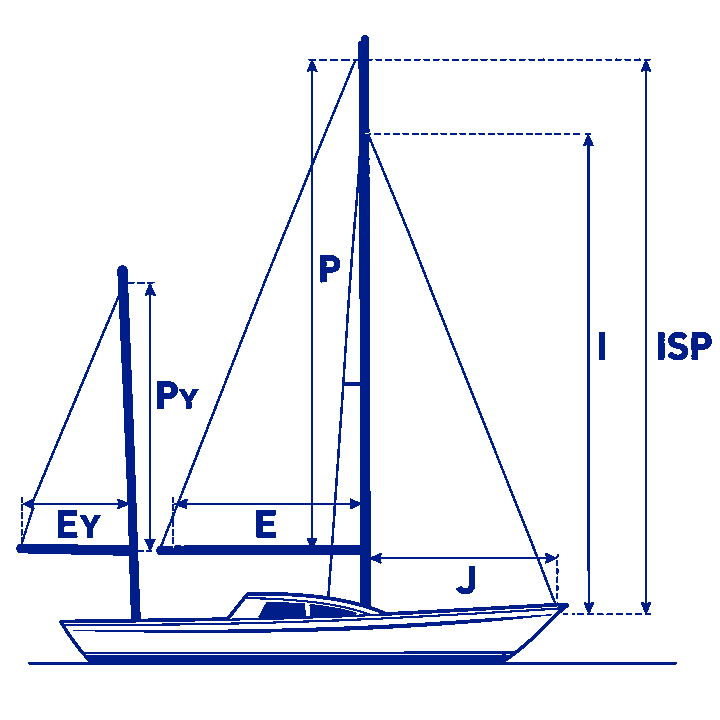
| SA/D · SAIL AREA TO DISPLACEMENT | 18.38 Below 16 is considered conservative sail power, 16–20 moderate sail power, and above 20 high sail power. |
|---|---|
| D/L · DISPLACEMENT TO LENGTH | 212 |
| S-NUMBER | 2.72 Calculated from SA/D and D/L (Brewer) |
| CSF | 2.12 Above 2.0: generally does not meet the traditional offshore screening guideline (not a seaworthiness rating). |
| Ballast/displacement | 48.5% ↗ Below roughly 30% can suggest a more tender boat, around 35% is common for cruisers, and 40% or more can suggest greater resistance to heeling. Keel depth, ballast placement, and hull shape also matter. |
| Theoretical hull speed | 6.3 kn ↗ |
| Waterline length | 22' 2" |
| Ballast | 2,512 lb |
| Advertised sail area | 344 ft²↗ |
| Foretriangle area | 193.88 ft² ↗ |
| Mainsail triangle | 149.63 ft² ↗ |
| Estimated forestay (published standard rig) | 35.03 ft ↗ |
Rig dimensions by configuration
| Published model reference | I | J | P | E | 100% triangular sail area |
|---|---|---|---|---|---|
| Published rig | 33′ | 11′9″ | 28′6″ | 10′6″ | 343.5 ft² |
100% triangular sail area = (I × J + P × E) / 2. Source ↗
Construction & Equipment
Production history
Number built: 975
Mk I
- Original C&C 27: 27 ft 4 in LOA, 4 ft 3 in draft, 2,512 lb of ballast, with a single upper and single lower shroud.
- Mainsail traveller sat aft in the cockpit. Tiller steering and an Atomic 4 gas engine were standard.
- A taller rig (2 ft taller mast, 'Mark I TM') was also offered.
- Published figures: displacement 5,180 lb, sail area 344 sq ft.
- Published figures: length overall 27.33 ft, waterline 21 ft, beam 9.17 ft, draft 4.25 ft, ballast 2,512 lb.
- Sources disagree: Waterline: owners' association says 21 ft 0 in; sailboatdata.com says 22.17 ft. The association figure is used.
- Sources disagree: PHRF: PHRF-NE lists 207 for the 27-1; Wikipedia gives an average of 195 and Practical Sailor about 200.
- Sources disagree: Last Mk I hull: the association's text says hull 215 but its table and other sources say 167.
Mk II
- Same hull and sail area as the Mk I, but the high-aspect rig is two feet taller.
- Standing rigging changed to one upper and two lower shrouds.
- Aft traveller, Atomic 4 engine and tiller steering were carried over from the Mk I.
- Displacement given as 5,500 lb against 5,180 lb for the Mk I; ballast stays 2,512 lb.
- Published figures: length overall 27.33 ft, waterline 21 ft, beam 9.17 ft, draft 4.25 ft, ballast 2,512 lb.
- Published figures: displacement 5,500 lb.
- Sources disagree: PHRF: PHRF-NE lists 201 for the 27-1 TM (which its variants sheet equates to the Mk II); Practical Sailor says about 195 and Wikipedia 192.
- Sources disagree: Hull numbers: the association's text says Mk II starts at hull 216, its table says 168, and sailboatdata.com says 168-452.
Mk III
- Cast from a new mould: LOA grew from 27 ft 4 in to 27 ft 10.5 in and waterline from 21 ft to 22 ft 10.5 in.
- Draft increased from 4 ft 3 in to 4 ft 6 in, and ballast fell from 2,512 lb to 2,116 lb.
- Taller rig with more sail area, and the traveller moved forward to a bridgedeck mount.
- Wheel steering became an option in 1975, and a Yanmar diesel became an option in 1978.
- Published figures: sail area 372 sq ft.
- Published figures: displacement 5,500 lb.
- Published figures: length overall 27.88 ft, waterline 22.88 ft, beam 9.17 ft, draft 4.5 ft, ballast 2,116 lb.
- Sources disagree: Draft: the association says 4 ft 6 in; sailboatdata.com gives 4.75 ft, sailboat.guide 4 ft 9 in, and the PHRF-NE sheet 4.46 ft. The association figure is used.
- Sources disagree: Displacement: sailboatdata.com and Wikipedia give 5,500 lb; Practical Sailor's review says it rose to 5,800 lb.
- Sources disagree: Sail area: sailboat.guide gives 372 sq ft total; sailboatdata.com lists a reported 344 sq ft.
Mk IV
- Same dimensions as the Mk III, but the forestay moved aft about four inches to make room for a bow roller.
- The shorter forestay base reduced J from 11.75 ft to 11.17 ft.
- Interior mostly cosmetic changes: teak replaced with off-white melamine trimmed in teak and dark-anodized aluminum.
- Auxiliary power became a Yanmar 2GM diesel.
- Published figures: length overall 27.88 ft, waterline 22.88 ft, beam 9.17 ft, draft 4.5 ft, ballast 2,116 lb.
- Sources disagree: Hull numbers: the association text says Mk IV ends at hull 984, its table says 979, and sailboatdata.com says 972.
- Sources disagree: Wikipedia credits the Mk IV with 56 boats built, while the association hull numbers imply about 65.
Full specifications
Every figure links to the page it came from. Anything not shown is not yet confirmed by a published source.
Identity
Hull measurements
Construction
Rig and sails
Engine, propulsion, systems
Accommodation
Practical ownership
Surveys and Market Value
No surveys have been contributed for this boat yet.
When owners contribute surveys, we plan to share anonymized recurring issues and used-boat value ranges, helping future buyers know what to inspect and what similar boats are worth. Survey uploads are coming soon.
Your privacy matters.
We plan to remove names, contact details, precise locations and vessel identifiers before sharing aggregated findings and value ranges. Individual survey documents will not be published.
Community contributions
Sign in
Comments
No comments yet.