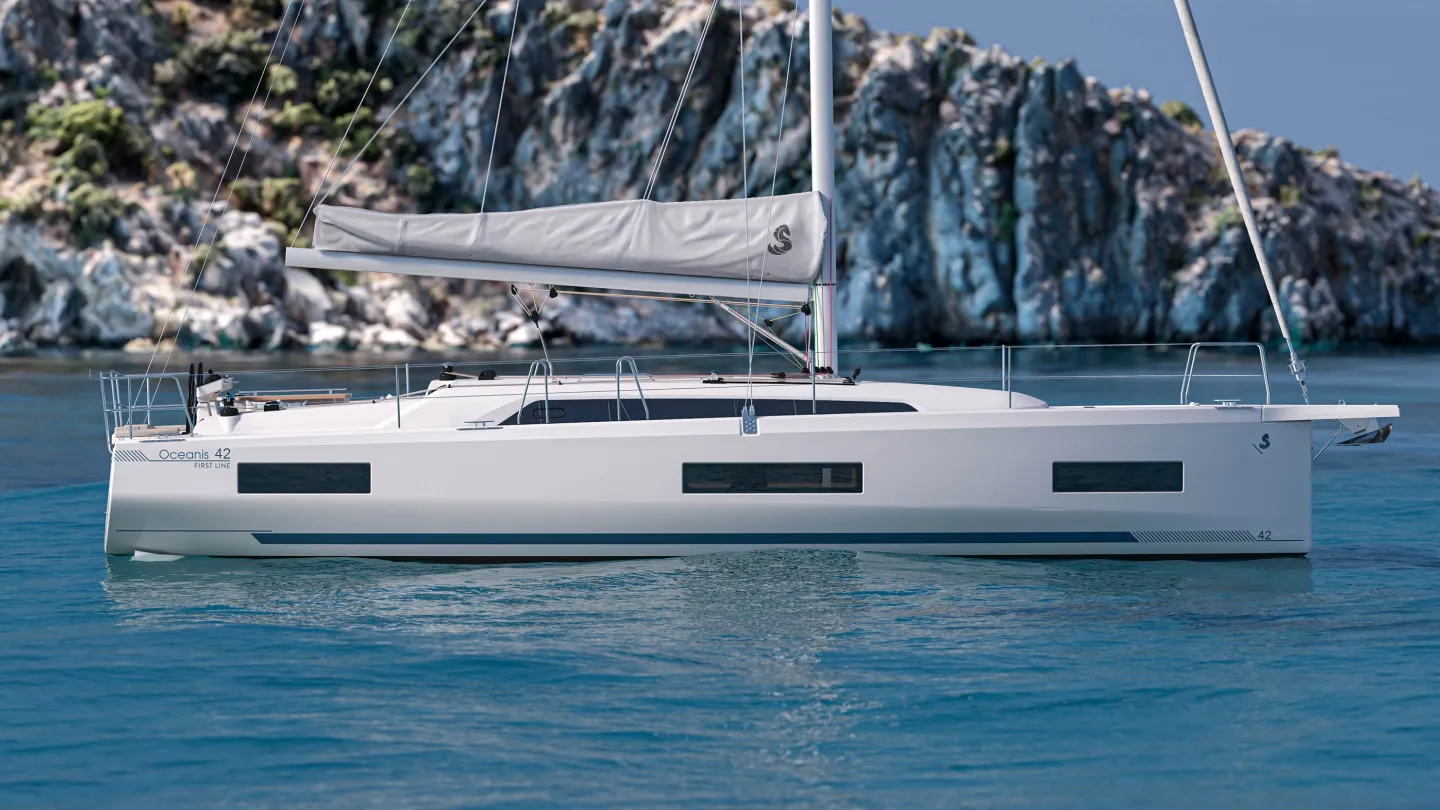
Figures link to the page they came from where one is published. Anything not shown is not yet confirmed by a published source.
Identity
Designer
Marc Lombard Yacht Design
beneteau.com ↗Naval architecture by Marc Lombard Yacht Design. Nauta Design is responsible for exterior and interior styling. This is the new Oceanis 42 introduced in 2026, replacing the Oceanis 40.1.
First year built
2026
solovela.net ↗Solovela identifies production beginning in 2026. Beneteau announced the model in July 2026, displayed it at Cannes in September 2026 and scheduled its formal world premiere for the November 2026 Paris Nautic Show.
Country built
France
pressmare.it ↗Pressmare identifies Beneteau's Le Grand Large production site in Givrand, Vendée, France.
Boat type
Sailing monohull
solovela.net ↗Modern fiberglass cruising sailing monohull.
Hull measurements
Length overall
42.17 ft
pro.beneteau.fr ↗Beneteau's October 29, 2026 specification. Overall length is 12.86 m / 42 ft 2 in, including the bow projection. Hull length is separately specified as 39 ft 4 in.
Length on deck
39.33 ft
pro.beneteau.fr ↗Builder's hull-length measurement. This is shorter than the 42 ft 2 in overall length, which includes the bow projection.
Waterline length
37.5 ft
pro.beneteau.fr ↗Factory-published waterline length, 11.42 m. Sailboat Performance independently converts this to 37.47 ft.
Beam (widest)
13.92 ft
pro.beneteau.fr ↗Beneteau's rounded imperial beam. Sailboat Performance gives 13.88 ft from the same 4.23 m metric specification.
Draft (standard keel)
7.42 ft
pro.beneteau.fr ↗Deep fin keel. Standard deep cast-iron fixed keel with ballast bulb, drawing 2.25 m / 7 ft 5 in. The alternative shallow fixed keel draws 5 ft 6 in and is recorded separately.
Draft (alternate keel 1)
5.5 ft
pro.beneteau.fr ↗Shoal fin keel. Optional fixed shallow cast-iron keel, drawing 1.68 m / 5 ft 6 in, with 2,237 kg / 4,930 lb of ballast. It is the shallower of the two documented production keel choices.
Air draft (clearance height)
60.25 ft
pro.beneteau.fr ↗Standard in-mast furling rig air draft. Beneteau expressly excludes antennae from this measurement. Optional classical mast air draft: 61.42.
Hull speed
8.21 kt
Calculated: 1.34 x the square root of the waterline length (37.5 ft).
Displacement (light / design)
17,600 lb
pro.beneteau.fr ↗Manufacturer's provisional CE light displacement. Yachting News independently converts 7,985 kg to 17,604 lb, a rounding difference rather than a documented alternative displacement or hull version. Other published figure: 17604.
Ballast weight
4,518 lb
pro.beneteau.fr ↗Ballast for the standard deep cast-iron keel. The optional shallow keel carries 4,930 lb according to the same manufacturer specification.
Ballast material
Cast iron
pro.beneteau.fr ↗Both deep and shallow keel alternatives are specified as cast iron.
Ballast / displacement ratio
25.7
Calculated: ballast divided by displacement, using the published figures on this page.
Rig and sails
Rig type
Sloop
pro.beneteau.fr ↗Single-masted fractional sloop with a mainsail and one primary headsail. Standard rig has an in-mast furling mainsail and self-tacking jib. A 105% genoa and conventional performance mainsail are optional.
Rig options offered
Standard roller-furling mast, performance classical mast, and First Line aluminum performance pack
pro.beneteau.fr ↗Mast material
Aluminium
pro.beneteau.fr ↗Anodized aluminum mast. The standard furling mast is supplied by Z-Diffusion, and the optional First Line pack is identified as an aluminum rig configuration.
Mast stepping
Deck-stepped
pro.beneteau.fr ↗Manufacturer specifies a deck-stepped furling mast. No keel-stepped or rotating mast alternative was identified.
Rig dimension I (foretriangle height)
Rig dimension J (foretriangle base)
15.33 ft
pro.beneteau.fr ↗Foretriangle base, identical in the manufacturer's standard and performance mast specification tables.
Rig dimension P (mainsail luff)
49.83 ft
pro.beneteau.fr ↗Standard roller-furling mainsail luff dimension. The optional performance classical mast has P = 15.70 m / 51 ft 6 in. Other published figure: 51.5.
Rig dimension E (mainsail foot)
16.75 ft
pro.beneteau.fr ↗Standard roller-furling mast E dimension. Performance classical mast E dimension: 16.42.
Mainsail area
406 sq ft
pro.beneteau.fr ↗Standard in-mast furling mainsail. Other published figure: 485.
Forestay length
52.3 ft
Calculated: the square root of (I squared + J squared), using the published rig dimensions on this page.
Headsail / genoa area
309 sq ft
pro.beneteau.fr ↗Standard self-tacking jib with roller-furling mast. Beneteau does not specify a percentage for this jib. Other published figure: 383. Other published figure: 324. Other published figure: 400.
Spinnaker / gennaker area
2,012 sq ft
pressmare.it ↗Asymmetric spinnaker, the largest published downwind sail. The 187-square-metre figure comes from the July 2026 provisional specifications. The November 2026 builder equipment list confirms asymmetric spinnaker rigging is offered but does not repeat the sail area.
Displacement / Length ratio
149.0
Calculated: (displacement in long tons) divided by (0.01 x waterline length) cubed, using the published figures on this page.
Capsize screening value
2.14
Calculated: beam divided by the cube root of (displacement in lb / 64), using the published beam and displacement on this page.
Motion comfort ratio (Brewer)
20.97
Calculated with Brewer's formula from this page's displacement, waterline length, overall length and beam.
Engine, propulsion, systems
Original engine make
Yanmar
pro.beneteau.fr ↗Factory Yanmar diesel driving a conventional propeller shaft, not a saildrive.
Original engine model
Yanmar 4JH45
pro.beneteau.fr ↗Factory-specified Yanmar 4JH45 common-rail diesel with conventional shaft drive. Beneteau specifies a fixed three-blade propeller as standard and optional folding propeller.
Fuel capacity
52 gal
pro.beneteau.fr ↗Standard rotomoulded diesel tank beneath the port aft berth. Beneteau specifies US gallons.
Fresh water capacity
62 gal
pro.beneteau.fr ↗Manufacturer's published standard freshwater capacity. The equipment list separately identifies a 195 L rotomoulded freshwater tank and a 40 L hot-water heater. Other published figure: 87.
Holding tank capacity
21 gal
pro.beneteau.fr ↗Standard aft head holding-tank capacity. The optional second forward head has a separate 50 L holding tank in the manufacturer's equipment specification. Layouts with up to three heads are offered, but no single builder-stated combined holding-tank capacity covers every arrangement.
Accommodation
Cabins
2
beneteau.com ↗Two-cabin owner's configuration, with one head and a dedicated workshop/storage compartment. Other published figure: 3. Other published figure: 4.
Heads (count, enclosed or not)
1
beneteau.com ↗One-head configuration is available with two or three cabins. Other published figure: 2. Three-cabin: 3.
Navigation station
Yes
pro.beneteau.fr ↗Dedicated portside chart/navigation desk with electrical control panel and storage. Beneteau also describes it as a full-size desk facing the saloon seating.
Headroom (saloon)
6.58 ft
pro.beneteau.fr ↗Builder's saloon headroom, specifically in the starboard saloon area of the standard owner's layout. The chart-table headroom is separately listed as 6 ft 6 in.
Practical ownership
Strengths (sourced)
Spacious cockpit, five interior configurations, two galley arrangements, flexible rig choices, large windows and straightforward cruising layout.
yacht.de ↗YACHT highlights the increase in cockpit space and wider hull, plus two aft-cockpit configurations and five accommodation plans. Cruising World independently identifies the increased sail area and layout flexibility as key features.
Owners' association link
boauk.org boauk.org ↗Beneteau UK Owners Association, established in 1995. This is a general Beneteau owners' association accepting all Beneteau models, not a dedicated Oceanis 42 class association. No model-specific owners' association for the 2026 design was identified.
Calculated from the figures above
Pounds per inch of immersion (estimate)
1865.3
Estimated, not measured: waterline length x beam x 0.67 (typical waterplane coefficient) x 64 / 12, using the published figures above.