Valiant 40

Valiant

Valiant 40 is a 39.9 ft cutter sailboat built by Valiant and designed by Bob Perry. It has a hull speed of 7.81 kt and a fin (standard deep), fin (shoal) and custom-depth fin keel.
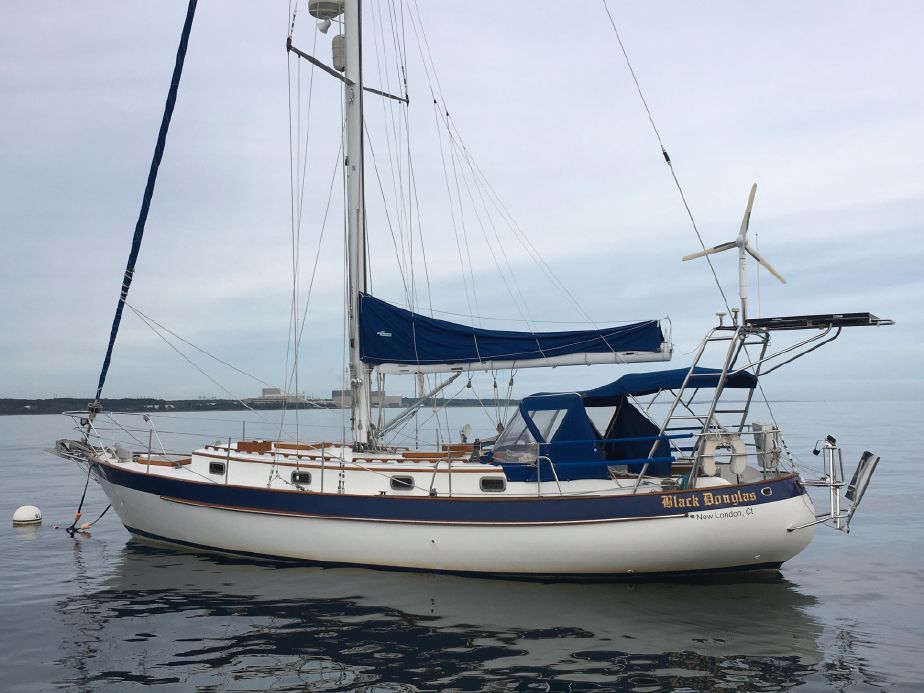
Valiant 40
SpinSheet · Photo source
Community photos are ranked by votes.Add your photo

At a glance

Length
39.9 ft↗
Beam
12.33 ft↗
Draft
  • Standard keel6 ft
  • Shoal fin keel5.25 ft
  • Custom-depth fin keel5.17 ft
↗↗
Displacement
Valiant 40-1: 23,520 lb | 22,500 lb↗
Ballast
Valiant 40-1: 8,400 lb | 7,700 lb↗
Rig
Cutter↗
Built
1973–1992
Hull speed
7.81 kt
Headroom
6.17 ft↗

The quick verdict

The Valiant 40 suits serious offshore cruisers who prioritize dependable sailing characteristics, robust construction and practical passagemaking accommodations. Its greatest strengths are its balanced cutter rig, strong hull, comfortable motion and excellent long-distance reputation. The major buying risk is severe laminate blistering in some early Uniflite boats, compounded by the maintenance needs of aging systems. Buyers should prioritize a detailed structural survey, especially the hull laminate, keel bolts, rigging, tanks and original through-hull fittings.

Shopping for a boat like this?

Tell us how you'll sail and who's coming along. The Boat Picker asks a few quick questions and shows which boats fit your plans, so you can skip the guesswork.

Try the Boat Picker

All specifications

Production years
1973–1992
Designer
Bob Perry↗

Dimensions & rating

Length overall
39.9 ft↗
Beam
12.33 ft↗
PHRF
132↗
Displacement
Valiant 40-1: 23,520 lb | 22,500 lb↗
Hull speed
7.81 kt
Standing headroom
6.17 ft↗
Draft by configuration↗↗
Standard keel6 ft
Shoal fin keel5.25 ft
Custom-depth fin keel5.17 ft
Rudder type
Skeg-hung↗
Twin wheels
No↗
Rig type
Cutter↗
Mast step
Keel-stepped↗

Standardized sailing characteristics

Speed

PHRF 132

Lower PHRF means a faster racing handicap. Rig, keel, and region affect ratings.

Reference source ↗

Comfort at Sea

Catalina 22 Mk IIPrecision 28Oceanis 37Catalina 30Island Packet 38Oyster 53
34.26

This boat's motion comfort ratio: a comparison of how gently a design moves at sea. A higher number is gentler. It does not rate cabin space or guarantee comfort.

Capsize screening (CSF)

Catalina 22 Mk IIPrecision 28Oceanis 37Catalina 30Island Packet 38Oyster 53
CSF 1.75

The Capsize Screening Formula: beam compared with displacement. A lower number means a boat is less prone to capsize, so the scale runs from least to most capable offshore; 2.0 or below is the usual guide. It is a screening figure, not a safety guarantee.

Measurements

Rig diagram & sailing measurements

Rig dimension reference
Rig measurement diagram showing I, ISP, J, P, E, PY and EY
General rig reference. PY and EY apply to boats with a mizzen mast.
CSF1.75
Below 2.0: generally meets the traditional offshore screening guideline (not a seaworthiness rating).
Rig dimension I (foretriangle height)50.3 ft↗
Rig dimension J (foretriangle base)18.5 ft↗
Rig dimension P (mainsail luff)45 ft↗
Rig dimension E (mainsail foot)Valiant 40-1: 15.25 ft / Valiant 40-2: 13.6 ft↗
Forestay length53.59 ft
Sail area (base / working)Valiant 40-1: 807.94 sq ft / 772 sq ft↗
Mainsail areaValiant 40-1: 343.13 sq ft / Valiant 40-2: 306 sq ft↗
Headsail / genoa areaValiant 40-1: 464.81 sq ft / Valiant 40-2: 465.3 sq ft↗
Air draft (clearance height)55 ft↗
Ballast / displacement ratio34.2
Hull speed7.81 kt

Construction

Construction

Hull material
Fiberglass ↗
Hull cored below waterline
No ↗
Hull cored above waterline
No ↗
Hull core material
None ↗
Deck cored
Yes ↗
Deck core material
Balsa ↗
Hull-to-deck joint
Inward flange ↗
Structural grid / pan liner
Glassed-in transverse Divinycell floor timbers and bonded bulkheads; no molded interior pan ↗
Keel type
Fin (standard deep), fin (shoal) and custom-depth fin ↗
Keel material
Lead ↗
Keel attachment
Bolted ↗
Rudder type
Skeg-hung ↗
Number of rudders
1 ↗
Twin wheels
No ↗
Steering type
Wheel ↗
Fuel tank material
Aluminium ↗
Fresh water tank material
High-density polyethylene ↗

Construction & Equipment

Tankage

Fuel capacity
90 gal ↗
Factory configuration without the generator option, as described by Practical Sailor. Other published figure: 110. Other published figure: 95.
Fresh water capacity
140 gal ↗
Two tanks beneath the port and starboard settees on the version described by Practical Sailor. Other published figure: 120.
Holding tank capacity
15 gal ↗
Cruising World's representative holding-tank capacity. Individual semi-custom boats may differ.

Accommodation

Headroom (saloon)
6.17 ft ↗
Approximately 6 ft 2 in. Cruising World more conservatively summarizes cabin headroom as 6 ft plus.

Production history

Valiant 40-1

1973–1980

Valiant 40-2

1981–1992

Full specifications

Figures link to the page they came from where one is published. Anything not shown is not yet confirmed by a published source.

Identity

Designer
Bob Perry cruisingworld.com ↗
Also credited as Robert H. Perry by other sources. The designer remained the same throughout production.
First year built
Valiant 40-1: 1973 practical-sailor.com ↗
Practical Sailor dates the first launch to 1973. Cruising World gives 1975 for the beginning of Uniflite's production count.
Valiant 40-2: 1981
A 1981 Valiant 40-2 is also identified by an owner at OddGodfrey.
Last year built
Valiant 40-1: 1980
No independent factory announcement defining the exact 40-1/40-2 changeover date was found.
Valiant 40-2: 1992 spinsheet.com ↗
SpinSheet explicitly states that production continued until 1992, when the Valiant 42 replaced it.
Number built
200 spinsheet.com ↗
Exact-model production count from naval architect and surveyor Jack Hornor's review. Cruising World separately reports that Uniflite built 159 before the production operation was transferred; 159 is not the total.
Country built
United States spinsheet.com ↗
Production began in Washington State, then continued in Texas after Rich Worstell acquired Valiant in 1984. Both locations are in the United States.
Boat type
Sailing monohull cruisingworld.com ↗
Single-hulled offshore sailing cruiser.
Hull type
Monohull

Hull measurements

Length overall
39.9 ft valiantsailboats.com ↗
Original builder's brochure. Cruising World rounds LOA to 39 ft 11 in.
Waterline length
Beam (widest)
Draft (standard keel)
6 ft valiantsailboats.com ↗
Standard deep fin keel. The builder also offered a 5 ft 3 in shoal draft and customized intermediate keel depths. Practical Sailor recommends the normal 6 ft keel for sailing performance.
Draft (alternate keel 1)
5.25 ft valiantsailboats.com ↗
Shoal fin keel. Manufacturer's explicitly advertised shallow-draft option. Practical Sailor confirms a shoal fin and custom intermediate keel depths.
Draft (alternate keel 2)
5.17 ft practical-sailor.com ↗
Custom-depth fin keel. Practical Sailor states a minimum of 5 ft 2 in and reports custom depths in two-inch increments. This differs from the manufacturer's advertised 5 ft 3 in shoal option; the actual shallowest factory specification is therefore disputed.
Air draft (clearance height)
55 ft cruisingworld.com ↗
Published mast height above water. Masthead antennas, wind instruments and other fittings may increase actual bridge-clearance requirements.
Hull speed
7.81 kt
Calculated: 1.34 x the square root of the waterline length (34 ft).
Displacement (light / design)
Valiant 40-1: 23,520 lb
Conflicting early 40-1 database displacement, also shown for the 200-235 series. The builder's 22500 lb figure remains the preferred general design figure.
22,500 lb valiantsailboats.com ↗
Manufacturer's published design displacement, not independently confirmed as an empty or lightship measurement. Cruising World agrees.
Ballast weight
Valiant 40-1: 8,400 lb
Practical Sailor documents keel and ballast changes during production but does not assign this exact figure to a particular revision.
7,700 lb valiantsailboats.com ↗
The manufacturer identifies the ballast as external lead.
Ballast material
Lead valiantsailboats.com ↗
Original manufacturer specification. Practical Sailor describes an external lead casting.
Ballast / displacement ratio
34.2
Calculated: ballast divided by displacement, using the published figures on this page.

Rig and sails

Rig type
Cutter spinsheet.com ↗
Masthead cutter with an inner forestay for the staysail. Practical Sailor notes that a removable inner forestay was an available option, permitting sloop-style sailing.
Rig options offered
Early longer-boom cutter with end-boom sheeting; later shorter-boom cutter with mid-boom sheeting cruisingworld.com ↗
Cruising World also reports a slightly taller later rig.
Number of masts
1 spinsheet.com ↗
Single-masted cutter configuration.
Mast material
Aluminium boatparts.app ↗
Spar-Tech aluminum spars, corroborated by Practical Sailor's description of the Spar-Tech tapered, welded and painted mast.
Mast stepping
Keel-stepped boatparts.app ↗
The mast is supported internally on a fabricated aluminum H-beam secured to the floor timbers, as described by Practical Sailor. Individual boats may have been modified, so inspect actual mast support.
Sail area (base / working)
Valiant 40-1: 807.94 sq ft
Earlier long-boom rig's geometric sail area. The same database lists 810 sq ft reported. This difference is associated with the larger early mainsail triangle, not a different hull.
772 sq ft valiantsailboats.com ↗
Factory-published working sail area, also identified by Cruising World as the 100-percent sail area. Corresponds closely to the later rig's 771.28 sq ft geometric triangle calculation.
Rig dimension I (foretriangle height)
50.3 ft mauripro.com ↗
Sailmaker rig dimension for the 40-2.
Rig dimension J (foretriangle base)
Rig dimension P (mainsail luff)
45 ft mauripro.com ↗
Published standard mainsail luff dimension, also recorded for the earlier rigs.
Rig dimension E (mainsail foot)
Valiant 40-1: 15.25 ft
Original longer-boom rig, used on the earliest boats. The 200-235 series already had the shorter 13.6 ft boom dimension, so this figure does not apply to every 40-1. Other published figure: 13.6.
Valiant 40-2: 13.6 ft mauripro.com ↗
Short-boom rig used for the 40-2.
Forestay length
53.59 ft
Calculated: the square root of (I squared + J squared), using the published rig dimensions on this page.
Headsail / genoa area
Valiant 40-1: 464.81 sq ft
100 percent foretriangle for the original long-boom rig, not the area of a particular high-cut yankee or overlapping genoa.
Valiant 40-2: 465.3 sq ft mauripro.com ↗
100 percent headsail triangle.
Mainsail area
Valiant 40-1: 343.13 sq ft
Original longer-boom rig's geometric mainsail triangle. The figure is supported by the published 45 ft P and 15.25 ft E dimensions; actual sail area may differ.
Valiant 40-2: 306 sq ft practical-sailor.com ↗
Displacement / Length ratio
255.6
Calculated: (displacement in long tons) divided by (0.01 x waterline length) cubed, using the published figures on this page.
Capsize screening value
1.75
Calculated: beam divided by the cube root of (displacement in lb / 64), using the published beam and displacement on this page.
Motion comfort ratio (Brewer)
34.26
Calculated with Brewer's formula from this page's displacement, waterline length, overall length and beam.

Engine, propulsion, systems

Original engine make
Westerbeke, Perkins and Volvo practical-sailor.com ↗
Documented factory-supplied diesel makes across the production run. Specific fitment must be checked against the production period; this list is not a claim that the three engines were simultaneous standard choices.
Original engine model
Valiant 40-1: Westerbeke Four-107 boatparts.app ↗
Identified as original equipment on the earliest Valiant 40s. Later engines included Perkins and other Westerbeke diesels.
Valiant 40-2: Volvo 2003 Turbo practical-sailor.com ↗
Factory-installed diesel documented in Practical Sailor's late-1980s review, not necessarily standard on every 40-2.
Fuel capacity
90 gal practical-sailor.com ↗
Factory configuration without the generator option, as described by Practical Sailor. Other published figure: 110. Other published figure: 95.
Original engine power
Valiant 40-1: 40 hp boatparts.app ↗
Westerbeke Four-107/Westerbeke 40 power reported for early boats.
Valiant 40-2: 42 hp practical-sailor.com ↗
Practical Sailor's engine section identifies the Volvo 2003 Turbo as 42 hp, though another passage in the same review calls it 43 hp. Cruising World gives 40 hp as a representative rating for various diesels.
Fresh water capacity
140 gal practical-sailor.com ↗
Two tanks beneath the port and starboard settees on the version described by Practical Sailor. Other published figure: 120.
Holding tank capacity
15 gal cruisingworld.com ↗
Cruising World's representative holding-tank capacity. Individual semi-custom boats may differ.

Accommodation

Cabins
2 oddgodfrey.com ↗
Common two-stateroom cruising arrangement, supported by Practical Sailor's description of forward and aft sleeping areas. Semi-custom configurations existed; this is not a guarantee that every boat has the same layout.
Heads (count, enclosed or not)
1 oddgodfrey.com ↗
One enclosed head in the usual configuration. Practical Sailor documents two standard interior arrangements with different head locations.
Navigation station
Yes practical-sailor.com ↗
Dedicated navigation station with chart table and electrical distribution equipment.
Headroom (saloon)
6.17 ft practical-sailor.com ↗
Approximately 6 ft 2 in. Cruising World more conservatively summarizes cabin headroom as 6 ft plus.

Practical ownership

Known issues (sourced to magazines / associations)
Severe laminate blistering in some 1976-1981 Uniflite hulls spinsheet.com ↗
Major model-specific inspection concern. Blisters may extend above the waterline and into the laminate, unlike typical small osmotic gelcoat blisters. The review reports that fewer than 20 percent of boats had severe blistering.
Strengths (sourced)
Fast, predictable and well-balanced offshore passagemaker cruisingworld.com ↗
Reported by circumnavigator Mark Schrader; performance depends on conditions and loading. Other published figure: Strong fiberglass hull and protected skeg-hung rudder. Firsthand owner experience: Versatile cutter rig with excellent heavy-weather sail handling.
Owners' association link
groups.io boatparts.app ↗
Valiant sailboats and Perry-design owners' discussion group. The group archive may require membership; its contents were not accessible during research.

Calculated from the figures above

Pounds per inch of immersion (estimate)
1498
Estimated, not measured: waterline length x beam x 0.67 (typical waterplane coefficient) x 64 / 12, using the published figures above.

Valiant 40 problems

Reported by owners and reviewers. Condition varies from boat to boat.

  • Severe laminate blistering in some 1976-1981 Uniflite hulls ↗
  • A Valiant 40-2 circumnavigating owner describes a balanced helm, smooth motion in large seas and predictable heaving-to, with relatively little effort required to steer. ↗
  • Circumnavigator Mark Schrader reports that his Valiant 40 remained dependable through more than 30,000 miles of singlehanded offshore sailing. ↗
  • An owner surveyed by boats.com praised the predictable handling and comfortable ocean motion of the Valiant 40. ↗

What the magazines say

Owner experiences and professional commentary are separate sources. Condition varies from boat to boat.

  • Practical Sailor praised the robust hull, hull-to-deck joint and machinery access, while recommending improved seacocks and additional emergency bilge-pumping capacity. Read source
  • Naval architect and surveyor Jack Hornor warns that certain early boats developed unusually severe laminate blisters, sometimes affecting the whole hull. Read source
  • A boats.com review based on owner responses gave high marks to offshore protection, watertightness, sea berths and structural strength, while noting lower hatch and port ratings. Read source

Valiant 40 documents

Links to the builder's and other published documents.

What's on file

Nothing from owners yet. If you own one, you can add a survey or receipts in My boats and help the next buyer.

Surveys and Market Value

No surveys have been contributed for this boat yet.

Up to 2 per boat, PDF under 4 MB (larger ones: add them from My boats). This can take up to a minute.

Watch the boat

Valiant 40 Sailboat | The Legendary Bluewater Cruiser Changed Offshore Sailing Ep 352 Lady K Sailing

Watch on YouTube ↗

Community contributions or corrections

Do you have information about this boat, a photo of it, or advice for future owners? Leave a comment below regarding this make and model. For corrections, leave the corrected information with the source so we can investigate and update the boat wiki page.

Sign in

Comments

No comments yet.