Pearson Triton

Pearson Yachts

Pearson Triton is a 28.33 ft sloop sailboat built by Pearson Yachts and designed by Carl Alberg, first produced in 1959. It has displacement of 6,930 lb, a hull speed of 6.07 kt and a full keel.
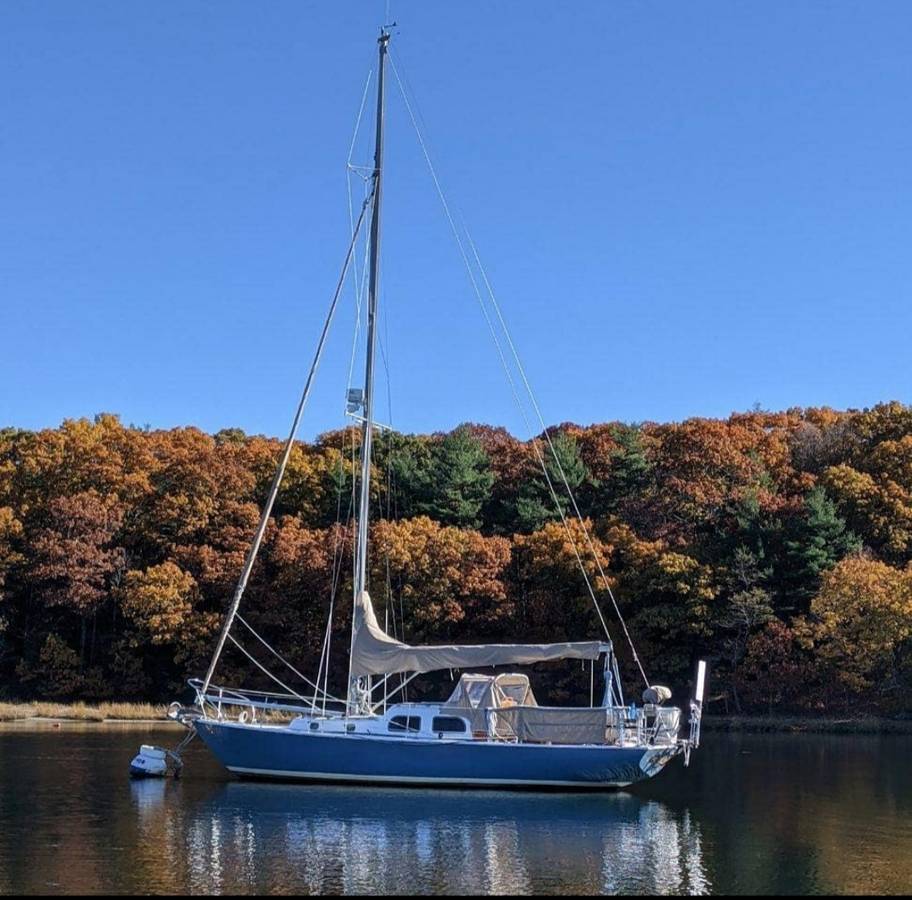
Pearson Triton
Pearson Yachts Owners Portal · Photo source
Community photos are ranked by votes.Add your photo

At a glance

Length
28.33 ft↗
Beam
8.25 ft↗
Draft
3.92 ft↗
Displacement
6,930 lb↗
Ballast
3,019 lb↗
Rig
Sloop↗
Built
1959–1967↗
Hull speed
6.07 kt
Headroom
6 ft↗

The quick verdict

The Pearson Triton is an excellent candidate for a sailor wanting an affordable, traditional small offshore cruiser with genuine passage-making history. Its biggest assets are the substantial fiberglass hull, forgiving long-keel handling and proven seaworthiness. The compromises are cramped accommodations, a rudimentary galley, modest speed and potentially extensive restoration costs. Survey the balsa deck core, mast-support structure, ballast attachment, rudder, rigging and engine before buying.

Shopping for a boat like this?

Tell us how you'll sail and who's coming along. The Boat Picker asks a few quick questions and shows which boats fit your plans, so you can skip the guesswork.

Try the Boat Picker

All specifications

Production years
1959–1967↗
Designer
Carl Alberg↗

Dimensions & rating

Length overall
28.33 ft↗
Beam
8.25 ft↗
PHRF
255↗
Displacement
6,930 lb↗
Hull speed
6.07 kt
Standing headroom
6 ft↗
Draft
3.92 ft↗
Keel type
Full↗
Rudder type
Keel-hung↗
Twin wheels
No↗
Rig type
Sloop↗
Mast step
Deck-stepped↗

Standardized sailing characteristics

Speed

PHRF 255

Lower PHRF means a faster racing handicap. Rig, keel, and region affect ratings.

Reference source ↗

Comfort at Sea

Catalina 22 Mk IIPrecision 28Oceanis 37Catalina 30Island Packet 38Oyster 53
28.19

This boat's motion comfort ratio: a comparison of how gently a design moves at sea. A higher number is gentler. It does not rate cabin space or guarantee comfort.

Capsize screening (CSF)

Catalina 22 Mk IIPrecision 28Oceanis 37Catalina 30Island Packet 38Oyster 53
CSF 1.73

The Capsize Screening Formula: beam compared with displacement. A lower number means a boat is less prone to capsize, so the scale runs from least to most capable offshore; 2.0 or below is the usual guide. It is a screening figure, not a safety guarantee.

Measurements

Rig diagram & sailing measurements

Rig dimension reference
Rig measurement diagram showing I, ISP, J, P, E, PY and EY
General rig reference. PY and EY apply to boats with a mizzen mast.
CSF1.73
Below 2.0: generally meets the traditional offshore screening guideline (not a seaworthiness rating).
Rig dimension I (foretriangle height)28.5 ft
Rig dimension J (foretriangle base)9.8 ft↗
Rig dimension P (mainsail luff)33 ft
Rig dimension E (mainsail foot)14 ft
Forestay length30.14 ft
Sail area (base / working)371 sq ft↗
Mainsail area231 sq ft↗
Headsail / genoa area140 sq ft↗
Spinnaker / gennaker area537.1 sq ft↗
Ballast / displacement ratio43.6
Hull speed6.07 kt

Construction

Construction

Hull material
Fiberglass ↗
Hull cored below waterline
No ↗
Hull cored above waterline
No ↗
Hull core material
None (solid laminate)
Deck cored
Yes ↗
Deck core material
Balsa ↗
Hull-to-deck joint
Bonded ↗
Keel type
Full ↗
Keel material
Lead ↗
Keel attachment
Bolted ↗
Rudder type
Keel-hung ↗
Number of rudders
1 ↗
Twin wheels
No ↗
Steering type
Tiller ↗
Fuel tank material
Metal ↗
Fresh water tank material
Fiberglass ↗

Construction & Equipment

Tankage

Fresh water capacity
28 gal ↗
Triton owner identifies the original factory freshwater tank as a 28-gallon fiberglass unit. Pearson's contemporary brochure independently confirms molded-fiberglass water-tank construction. Capacity is owner-documented rather than taken from an original builder specification.

Accommodation

Headroom (saloon)
6 ft ↗
Builder's historical brochure figure. Good Old Boat and Practical Sailor describe slightly more than six feet beneath the main doghouse and reduced headroom farther forward.

Full specifications

Figures link to the page they came from where one is published. Anything not shown is not yet confirmed by a published source.

Identity

Designer
Carl Alberg pearsonyachts.org ↗
Tom Potter initiated the project and Pearson adapted Alberg's design for fiberglass construction.
First year built
1959 practical-sailor.com ↗
The first Pearson-built Triton appeared at the January 1959 New York Boat Show.
Last year built
1967 practical-sailor.com ↗
Pearson's owners' historical table also gives 1959–1967. Some historical accounts state that Pearson stopped production in 1966, apparently reflecting manufacturing versus final launch dates.
Number built
750 pearsonyachts.org ↗
Historical approximate figure attributed to Pearson production. The same source separately reports approximately 125 Aeromarine-built Tritons in California. Other publications describe total production as more than 700 rather than giving a precise count.
Country built
United States goodoldboat.com ↗
Original Pearson-built boats were manufactured in Rhode Island.
Boat type
Sailing monohull practical-sailor.com ↗
Traditional single-hull auxiliary cruising sailboat.
Hull type
Monohull

Hull measurements

Length overall
28.33 ft janice142.com ↗
Original measurement reproduced from Sail magazine, January 1980. Other published figure: 28.5.
Waterline length
20.5 ft janice142.com ↗
Original Sail magazine figure, also supported by Pearson's owners portal and Good Old Boat.
Beam (widest)
8.25 ft janice142.com ↗
Pearson's historical table rounds this to 8.3 ft.
Draft (standard keel)
3.92 ft pearsonyachts.org ↗
Fixed full keel, originally approximately 3 ft 11 in. Good Old Boat rounds the draft to 4 ft. Practical Sailor reports that later encapsulated-ballast keels became approximately one inch deeper, a construction change rather than a separately marketed keel option.
Hull speed
6.07 kt
Calculated: 1.34 x the square root of the waterline length (20.5 ft).
Displacement (light / design)
6,930 lb pearsonyachts.org ↗
Other published figure: 8400.
Ballast weight
3,019 lb goodoldboat.com ↗
Published ballast weight for the original design. Ballast attachment changed from external keel bolts to encapsulation during production.
Ballast material
Lead goodoldboat.com ↗
Early boats carried external ballast, while later boats had cast lead encapsulated in the keel cavity.
Ballast / displacement ratio
43.6
Calculated: ballast divided by displacement, using the published figures on this page.

Rig and sails

Rig type
Sloop goodoldboat.com ↗
The original rig was a three-quarter fractional sloop with jumper struts. A shorter masthead sloop rig was offered later. Other published figure: Yawl.
Rig options offered
Original three-quarter fractional sloop; later shorter masthead sloop; optional yawl practical-sailor.com ↗
Practical Sailor documents a later shorter masthead option and a yawl with mainmast shortened approximately two feet and boom approximately one foot. Early rigs also changed from single to double lower shrouds after approximately hull 120. Sail dimensions must be matched to the specific rig.
Number of masts
1 goodoldboat.com ↗
Standard sloop configuration.
Mast material
Aluminium goodoldboat.com ↗
Original anodized aluminum spar. Pearson's historical brochure independently specifies corrosion-resistant aluminum-alloy spars.
Mast stepping
Deck-stepped goodoldboat.com ↗
Original mast supported by structure beneath the cabin top. Mast-support beam compression is a well-documented weakness.
Sail area (base / working)
371 sq ft goodoldboat.com ↗
Original fractional-sloop working sail area, consisting of approximately 231 sq ft mainsail and 140 sq ft working jib. Other published figure: 362.
Rig dimension I (foretriangle height)
28.5 ft
Published early fractional-sloop foretriangle height. Other published figure: 33.
Rig dimension J (foretriangle base)
Rig dimension P (mainsail luff)
33 ft
Original fractional-sloop mainsail hoist. Good Old Boat's sailplan likewise identifies a large mainsail. Other published figure: 30.3.
Rig dimension E (mainsail foot)
14 ft
Original fractional-sloop mainsail foot. Good Old Boat also describes the original boom as 14 ft long. Other published figure: 13.
Headsail / genoa area
140 sq ft goodoldboat.com ↗
Original fractional-sloop working jib, approximately the 100% foretriangle area. Larger overlapping genoas were also used, but their factory sizes and percentages were not established.
Mainsail area
231 sq ft goodoldboat.com ↗
Other published figure: 197.
Forestay length
30.14 ft
Calculated: the square root of (I squared + J squared), using the published rig dimensions on this page.
Spinnaker / gennaker area
537.1 sq ft ispinnakers.com ↗
Asymmetrical spinnaker, iSpinnakers iS7 recommendation for the fractional-rig Pearson Triton. The same sailmaker separately lists an iS6 of 482.2 sq ft for Pearson 28 Triton.
Displacement / Length ratio
359.1
Calculated: (displacement in long tons) divided by (0.01 x waterline length) cubed, using the published figures on this page.
Capsize screening value
1.73
Calculated: beam divided by the cube root of (displacement in lb / 64), using the published beam and displacement on this page.
Motion comfort ratio (Brewer)
28.19
Calculated with Brewer's formula from this page's displacement, waterline length, overall length and beam.

Engine, propulsion, systems

Original engine make
Universal pearsonyachts.org ↗
Original factory gasoline auxiliary. Modern diesel installations are repowers, not original equipment.
Original engine model
Atomic 4 pearsonyachts.org ↗
Four-cylinder gasoline inboard. Many surviving Tritons have been repowered with diesel engines or converted to outboard or electric propulsion.
Original engine power
30 hp pearsonyachts.org ↗
Original factory brochure rating, also used by Practical Sailor and Good Old Boat. Other published figure: 25.
Fresh water capacity
28 gal triton680.blogspot.com ↗
Triton owner identifies the original factory freshwater tank as a 28-gallon fiberglass unit. Pearson's contemporary brochure independently confirms molded-fiberglass water-tank construction. Capacity is owner-documented rather than taken from an original builder specification.

Accommodation

Berths (total)
4 pearsonyachts.org ↗
Original four-berth interior configuration. The original design request was for a 28-footer sleeping four. Other published figure: 6.
Heads (count, enclosed or not)
1 pearsonyachts.org ↗
Original single enclosed marine head amidships.
Headroom (saloon)
6 ft pearsonyachts.org ↗
Builder's historical brochure figure. Good Old Boat and Practical Sailor describe slightly more than six feet beneath the main doghouse and reduced headroom farther forward.

Practical ownership

Known issues (sourced to magazines / associations)
Water-damaged balsa deck cores, mast-support beam compression, deteriorating wooden rudders, early external keel-bolt corrosion, rigging tang and spreader-socket failures, aging Atomic 4 engines, and poor original icebox insulation. practical-sailor.com ↗
Documented by Practical Sailor and corroborated in Good Old Boat's review. Rigging and keel inspections are particularly important because of the boat's age.
Strengths (sourced)
Heavy solid-fiberglass hull, stable long-keel tracking, forgiving sailing characteristics, proven offshore capability, manageable size, and a substantial refit knowledge base among owners. practical-sailor.com ↗
Practical Sailor praises its balance, stability, tracking and offshore cruising capabilities. Good Old Boat separately identifies seaworthiness and low purchase cost as major attractions.
Owners' association link
pearsonyachts.org pearsonyachts.org ↗
Active independent Pearson owners' documentation portal. Historical references also identify the National Triton Association at tritonclass.org, but that association website could not be loaded during this research.

Calculated from the figures above

Sail area / displacement ratio
16.33
Calculated: sail area divided by (displacement in lb / 64) to the power 2/3, using the published sail area and displacement above.
Pounds per inch of immersion (estimate)
604.3
Estimated, not measured: waterline length x beam x 0.67 (typical waterplane coefficient) x 64 / 12, using the published figures above.

Pearson Triton problems

Reported by owners and reviewers. Condition varies from boat to boat.

  • Water-damaged balsa deck cores, mast-support beam compression, deteriorating wooden rudders, early external keel-bolt corrosion, rigging tang and spreader-socket failures, aging Atomic 4 engines, and poor original icebox insulation ↗
  • Circumnavigator James Baldwin considers the Triton an excellent singlehander's cruiser but warns buyers about wet decks, wooden rudders, chainplates and aging gasoline engines. ↗
  • Triton 381 owner Tim Lackey documented a 21-month restoration involving replacement deck core, interior reconstruction, complete rewiring, new plumbing, rigging and a diesel repower. ↗
  • The owner of Triton 680 reported replacing the original 28-gallon fiberglass water tank and relocating fuel storage to improve usable cockpit-locker space. ↗

What the magazines say

Owner experiences and professional commentary are separate sources. Condition varies from boat to boat.

  • Practical Sailor praised the Triton's substantial hull and forgiving sailing qualities while documenting mast-support compression, deck deterioration and aging rudders. Read source
  • Good Old Boat found the Triton seaworthy and relatively affordable but criticized the tiny galley, limited interior volume and maintenance demands of older examples. Read source
  • Soundings described the Triton as an early fiberglass-production success whose enduring appeal comes from traditional handling, straightforward construction and offshore credibility. Read source

Pearson Triton documents

Links to the builder's and other published documents.

What's on file

Nothing from owners yet. If you own one, you can add a survey or receipts in My boats and help the next buyer.

Surveys and Market Value

No surveys have been contributed for this boat yet.

Up to 2 per boat, PDF under 4 MB (larger ones: add them from My boats). This can take up to a minute.

Community contributions or corrections

Do you have information about this boat, a photo of it, or advice for future owners? Leave a comment below regarding this make and model. For corrections, leave the corrected information with the source so we can investigate and update the boat wiki page.

Sign in

Comments

No comments yet.