Pearson Ariel 26

Pearson Yachts

Pearson Ariel 26 is a 25.58 ft sloop sailboat built by Pearson Yachts and designed by Carl Alberg, first produced in 1962. It has displacement of 5,120 lb, a hull speed of 5.76 kt and a full keel.
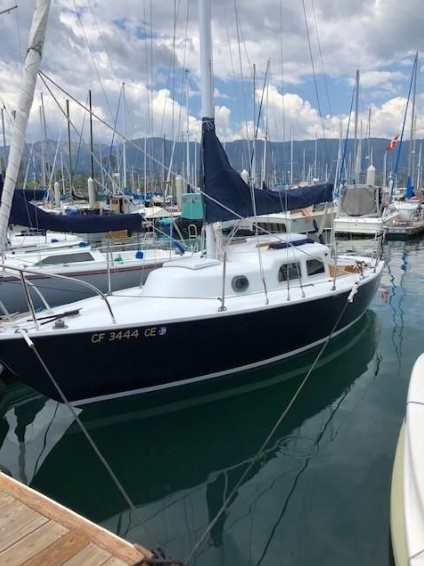
Pearson Ariel 26
Pearson Yachts Portal · Photo source
Community photos are ranked by votes.Add your photo

At a glance

Length
25.58 ft↗
Beam
8 ft↗
Draft
3.7 ft↗
Displacement
5,120 lb↗
Ballast
2,300 lb↗
Rig
Sloop↗
Built
1962–1966↗
Hull speed
5.76 kt
Headroom
5.92 ft↗

The quick verdict

The Pearson Ariel suits sailors seeking a traditional, compact cruiser who appreciate responsive handling and comfortable motion more than modern interior volume. Its heavy construction and protected rudder are attractive features for coastal cruising. Its principal weakness today is age-related structural deterioration, particularly around the deck core and mast support. Buy on structural condition rather than cosmetic appearance, and investigate the limitations of the original outboard well.

Standardized sailing characteristics

Speed

PHRF 253

Lower PHRF means a faster racing handicap. Published configurations: 243–264. Rig, keel, and region affect ratings.

Reference source ↗

Comfort at Sea

Catalina 22 Mk IIPrecision 28Oceanis 37Catalina 30Island Packet 38Oyster 53
24.04

This boat's motion comfort ratio: a comparison of how gently a design moves at sea. A higher number is gentler. It does not rate cabin space or guarantee comfort.

Capsize screening (CSF)

Catalina 22 Mk IIPrecision 28Oceanis 37Catalina 30Island Packet 38Oyster 53
CSF 1.86

The Capsize Screening Formula: beam compared with displacement. A lower number means a boat is less prone to capsize, so the scale runs from least to most capable offshore; 2.0 or below is the usual guide. It is a screening figure, not a safety guarantee.

Shopping for a boat like this?

Tell us how you'll sail and who's coming along. The Boat Picker asks a few quick questions and shows which boats fit your plans, so you can skip the guesswork.

Try the Boat Picker

Measurements

Rig diagram & sailing measurements

Rig dimension reference
Rig measurement diagram showing I, ISP, J, P, E, PY and EY
General rig reference. PY and EY apply to boats with a mizzen mast.
CSF1.86
Below 2.0: generally meets the traditional offshore screening guideline (not a seaworthiness rating).
Rig dimension I (foretriangle height)31.5 ft↗
Rig dimension J (foretriangle base)9.5 ft↗
Rig dimension P (mainsail luff)27 ft↗
Rig dimension E (mainsail foot)11.5 ft
Forestay length32.9 ft
Sail area (base / working)304.88 sq ft
Mainsail area155.3 sq ft
Headsail / genoa area149.63 sq ft
Ballast / displacement ratio44.9
Hull speed5.76 kt

All specifications

Production years
1962–1966↗
Designer
Carl Alberg↗

Dimensions & rating

Length overall
25.58 ft↗
Beam
8 ft↗
PHRF
253.4 (243–264)↗
Displacement
5,120 lb↗
Hull speed
5.76 kt
Standing headroom
5.92 ft↗
Draft
3.7 ft↗
Keel type
Full↗
Rudder type
Keel-hung↗
Twin wheels
No↗
Rig type
Sloop↗
Mast step
Deck-stepped↗

Construction

Construction

Hull material
Fiberglass ↗
Hull cored below waterline
No ↗
Hull cored above waterline
No ↗
Hull core material
None (solid laminate)
Deck cored
Yes ↗
Deck core material
Balsa ↗
Structural grid / pan liner
Bulkhead and mast-support strongback ↗
Keel type
Full ↗
Keel material
Fiberglass ↗
Keel attachment
Encapsulated ↗
Rudder type
Keel-hung ↗
Number of rudders
1 ↗
Steering type
Tiller ↗
Twin wheels
No ↗
Fresh water tank material
Galvanized steel ↗

Construction & Equipment

Accommodation

Headroom (saloon)
5.92 ft ↗
Original Pearson promotional specification.

Full specifications

Figures link to the page they came from where one is published. Anything not shown is not yet confirmed by a published source.

Identity

Designer
First year built
1962 pearsonyachts.org ↗
Designed in 1961; production began in 1962.
Last year built
1966 pearsonyachts.org ↗
Alternative published end year: 1967. An owner reports a 1968 example: 1968.
Number built
440 pearsonyachts.org ↗
Ariel production only; excludes the Commander.
Country built
United States
Built in Rhode Island.
Boat type
Sailing monohull seasailmakers.com ↗
Hull type
Monohull

Hull measurements

Length overall
Length on deck
Waterline length
18.5 ft goodoldboat.com ↗
Other published figure: 18.67.
Beam (widest)
Draft (standard keel)
3.7 ft goodoldboat.com ↗
Full keel. No alternative factory keel found. Full keel: 3.67.
Hull speed
5.76 kt
Calculated: 1.34 x the square root of the waterline length (18.5 ft).
Displacement (light / design)
5,120 lb atomvoyages.com ↗
Published design displacement; loading condition unspecified. Historical alternative figure: 5700.
Ballast weight
2,300 lb atomvoyages.com ↗
Historical alternative specification: 2500.
Ballast material
Ballast / displacement ratio
44.9
Calculated: ballast divided by displacement, using the published figures on this page.

Rig and sails

Rig type
Sloop harbormoor.com ↗
Masthead sloop.
Number of masts
1 harbormoor.com ↗
Single-mast sloop.
Mast material
Aluminium pearsonyachts.org ↗
Original Pearson brochure text.
Mast stepping
Deck-stepped pearsonac.org ↗
Cabin-top mast support with a structural strongback beneath.
Sail area (base / working)
304.88 sq ft
100 percent foretriangle plus mainsail triangle. Separately reported nominal sail area is 307 square feet.
Rig dimension I (foretriangle height)
Rig dimension J (foretriangle base)
Rig dimension P (mainsail luff)
Rig dimension E (mainsail foot)
11.5 ft
Matches the PHRF-derived dimensions published by L-36. Other published figure: 11.92.
Forestay length
32.9 ft
Calculated: the square root of (I squared + J squared), using the published rig dimensions on this page.
Mainsail area
155.3 sq ft
Calculated: half of P x E (27 x 11.5 ft), using the published rig dimensions on this page.
Headsail / genoa area
149.63 sq ft
100 percent foretriangle area, rather than the measured area of a particular finished sail.
Displacement / Length ratio
361.0
Calculated: (displacement in long tons) divided by (0.01 x waterline length) cubed, using the published figures on this page.
Capsize screening value
1.86
Calculated: beam divided by the cube root of (displacement in lb / 64), using the published beam and displacement on this page.
Motion comfort ratio (Brewer)
24.04
Calculated with Brewer's formula from this page's displacement, waterline length, overall length and beam.

Engine, propulsion, systems

Original engine make
Universal en.wikipedia.org ↗
Optional gasoline inboard. Alternatively supplied with an outboard motor well.
Original engine model
Atomic 4 en.wikipedia.org ↗
Optional original gasoline inboard.

Accommodation

Berths (total)
4 en.wikipedia.org ↗
Original Pearson promotional text also describes cruising accommodation for four.
Heads (count, enclosed or not)
1 en.wikipedia.org ↗
Period interior arrangements and subsequent owner modifications may differ.
Headroom (saloon)
5.92 ft pearsonyachts.org ↗
Original Pearson promotional specification.

Practical ownership

Known issues (sourced to magazines / associations)
Wet or deteriorated balsa deck core and deck delamination. pearsonac.org ↗
Inspect deck hardware penetrations, foredeck and cabin top. Inspect the strongback: Mast-support deterioration and voids around encapsulated ballast.. Applies to outboard-equipped boats: Original outboard well does not readily permit the engine to tilt clear of the water..
Strengths (sourced)
Strong construction and comfortable motion in rough water. goodoldboat.com ↗
The article explicitly discusses both the Ariel and Commander. Other published figure: Responsive handling and maneuverability under sail.. Other published figure: Established owners' association and restoration knowledge..
Owners' association link
pearsonac.org pearsonac.org ↗
Current association website replacing the legacy pearsonariel.org address.

Calculated from the figures above

Sail area / displacement ratio
16.42
Calculated: sail area divided by (displacement in lb / 64) to the power 2/3, using the published sail area and displacement above.
Pounds per inch of immersion (estimate)
528.9
Estimated, not measured: waterline length x beam x 0.67 (typical waterplane coefficient) x 64 / 12, using the published figures above.

Pearson Ariel 26 problems

Reported by owners and reviewers. Condition varies from boat to boat.

  • Wet or deteriorated balsa deck core and deck delamination ↗
  • Owners report deteriorated balsa beneath deck hardware and recommend isolating the core from future water penetration. ↗
  • An owner documented the differing reinforcement methods used beneath the cockpit sole and the surrounding cored deck. ↗
  • A former Ariel owner who sailed the boat for more than ten years praised its responsiveness and ability to tack through narrow channels. ↗
  • An Ariel owner undertaking a running refit found the boat sailed closer to the wind and faster than her previous Bristol 24. ↗

What the magazines say

Owner experiences and professional commentary are separate sources. Condition varies from boat to boat.

  • Yacht designer Ted Brewer describes the Ariel and Commander as traditional Alberg designs with substantial ballast ratios and narrow beams. Read source
  • Cruising author James Baldwin identifies the original motor well as a drawback because the outboard cannot easily be tilted clear while sailing. Read source
  • Good Old Boat describes the Ariel and its Commander sister design as strong, comfortable boats that sacrifice speed for good behavior in rough water. Read source

Pearson Ariel 26 documents

Links to the builder's and other published documents.

What's on file

Nothing from owners yet. If you own one, you can add a survey or receipts in My boats and help the next buyer.

Surveys and Market Value

No surveys have been contributed for this boat yet.

Community

Sign in

Be the first to comment.