Pearson 30
Pearson Yachts

- Production years
- 1971–1981
- Total built
- 1,185
- Designer
- William (Bill) Shaw
The quick verdict
The Pearson 30 is a well-built, good-sailing coastal cruiser and club racer. Many sell for roughly $5,000-$10,000. It is tender and not meant for offshore passages. Before you buy, have a surveyor check for wet balsa deck core, leaking through-hulls, rudder bushing play, hull dimples and the condition of the Atomic 4 engine.
Sails well and is responsive; Maneuvers well under power; Solid, overbuilt fiberglass hull; Light, roomy interior for 30 ft; Good resale and large owner community; Encapsulated keel means no keel-bolt worry
Tender/tippy; puts the rail down easily; Not a bluewater boat; coastal use only; Not very directionally stable; Hull flexible ('floppy') on later boats; Modest interior finish and no shower; Balsa-cored decks can leak and go soft; check for wet core; Hull 'oil canning' or dimples if blocked badly ashore; Rudder bushings wear out; Through-hull and seacock leaks; check hoses and fittings; Original Atomic 4 gas engine may need work; Deck, stanchion and window leaks
Find out whether this design suits your sailing plans with The Boat Picker.
Standardized sailing characteristics
Speed
Lower PHRF means a faster racing handicap. Rig, keel, and region affect ratings.
Reference source ↗Comfort at Sea
Raw Brewer Motion Comfort Ratio, a comparison of design motion at sea. It does not rate cabin space or guarantee comfort.
Measurements
Rig diagram & sailing measurements
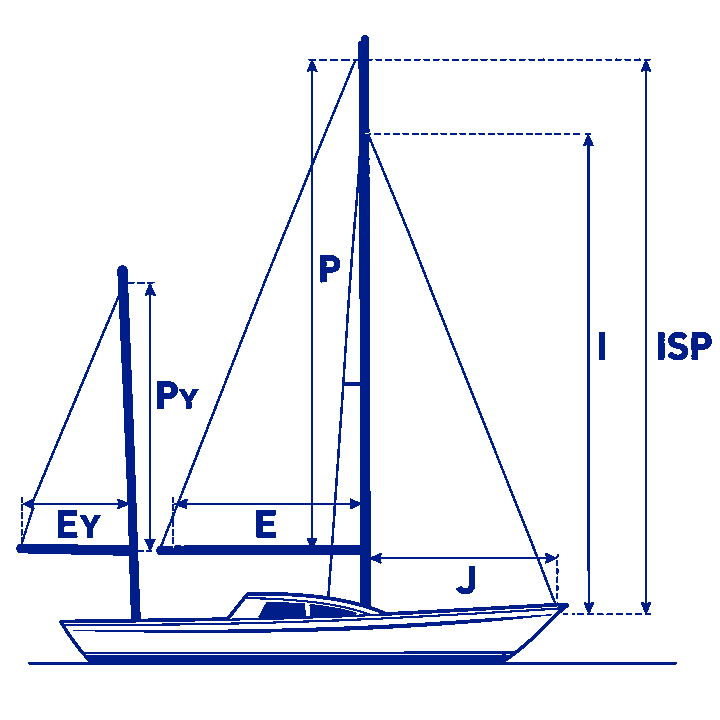
| SA/D · SAIL AREA TO DISPLACEMENT | 17.34 Below 16 is considered conservative sail power, 16–20 moderate sail power, and above 20 high sail power. |
|---|---|
| D/L · DISPLACEMENT TO LENGTH | 238 |
| S-NUMBER | 2.33 Calculated from SA/D and D/L (Brewer) |
| CSF | 1.88 Below 2.0: generally meets the traditional offshore screening guideline (not a seaworthiness rating). |
| Ballast/displacement | 42.8% ↗ Below roughly 30% can suggest a more tender boat, around 35% is common for cruisers, and 40% or more can suggest greater resistance to heeling. Keel depth, ballast placement, and hull shape also matter. |
| Theoretical hull speed | 6.7 kn ↗ |
| Waterline length | 25' |
| Ballast | 3,560 lb |
| Advertised sail area | 445 ft²↗ |
| Air draft | 42' |
| Foretriangle area | 247.07 ft² ↗ |
| Mainsail triangle | 198.15 ft² ↗ |
| Estimated forestay (published standard rig) | 41.01 ft ↗ |
Rig dimensions by configuration
| Published model reference | I | J | P | E | 100% triangular sail area |
|---|---|---|---|---|---|
| Published rig | 39′ | 12′8″ | 33′6″ | 11′10″ | 445.2 ft² |
100% triangular sail area = (I × J + P × E) / 2. Source ↗
Construction & Equipment
Production history
Number built: 1,185
Original
- Early boats had a Palmer 22 hp inboard; later ones got the 30 hp Universal Atomic 4 gasoline engine.
- Late-model boats came with a two-cylinder Universal diesel that weighs about the same as the Atomic Four.
- Through about hull number 200, Pearson used an aluminum rudder post that was prone to failure.
- Published figures: length overall 29.79 ft, waterline 25 ft, beam 9.5 ft, draft 5 ft, displacement 8,320 lb, ballast 3,560 lb, sail area 445 sq ft.
- Sources disagree: Sailboatdata gives 3,560 lb ballast; a Spinsheet review says 3,500 lb.
- Sources disagree: Sailboatdata and Wikipedia give production as 1971-1981; the Pearson Yachts Portal gives 1971–1980.
Full specifications
Every figure links to the page it came from. Anything not shown is not yet confirmed by a published source.
Identity
Hull measurements
Construction
Rig and sails
Engine, propulsion, systems
Accommodation
Practical ownership
Calculated from the figures above
Surveys and Market Value
No surveys have been contributed for this boat yet.
When owners contribute surveys, we plan to share anonymized recurring issues and used-boat value ranges, helping future buyers know what to inspect and what similar boats are worth. Survey uploads are coming soon.
Your privacy matters.
We plan to remove names, contact details, precise locations and vessel identifiers before sharing aggregated findings and value ranges. Individual survey documents will not be published.
Community contributions
Sign in
Comments
No comments yet.