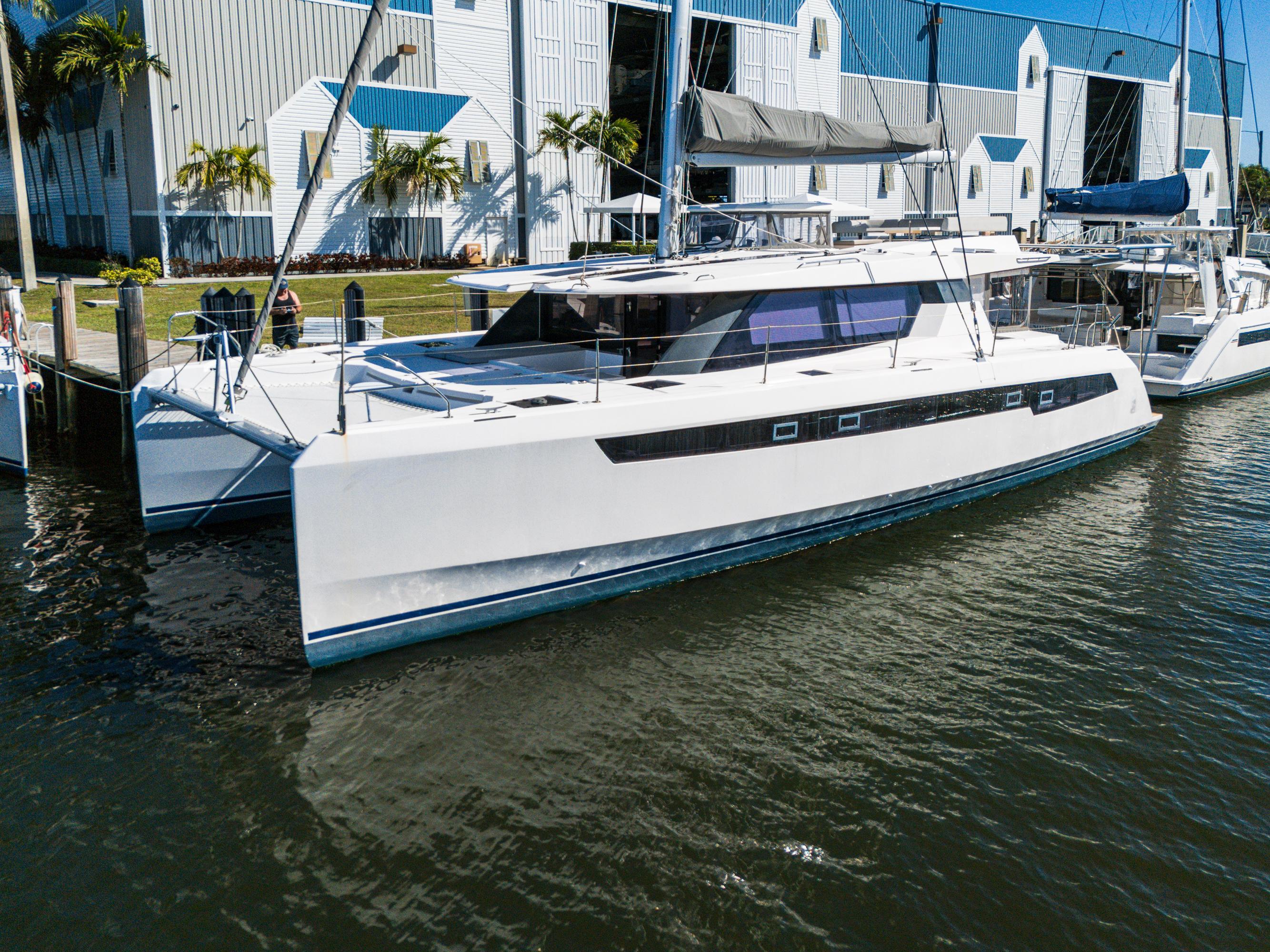
Figures link to the page they came from where one is published. Anything not shown is not yet confirmed by a published source.
Identity
Last year built
2025
leopardbrokerage.com ↗The builder's official brokerage model history identifies 2025 as the final year of Leopard 50 production overall.
Number built
240
leopardbrokerage.com ↗Combined production of the Leopard 50 design. No separate 50L/50P production counts are given.
Hull measurements
Beam (widest)
26.42 ft
sailmagazine.com ↗The builder confirms 26 ft 5 in / 8.04 m. Boat-Specs reports an inconsistent 27 ft 7 in, which is not adopted.
Draft (standard keel)
5.25 ft
sailmagazine.com ↗The manufacturer specifies this draft at half load. The design has fixed mini-keels, not retractable boards.
Air draft (clearance height)
80 ft
sailmagazine.com ↗SAIL lists 80 ft air draft. The builder separately lists mast height as 77 ft 2 in above the waterline at half load. The difference may reflect the definition of clearance height; verify actual masthead equipment before bridge passage.
Hull speed
9.37 kt
Calculated: 1.34 x the square root of the waterline length (48.88 ft).
Displacement (light / design)
41,888 lb
leopardcatamarans.com ↗The builder explicitly labels this figure Displacement (Light ship). This is the preferred manufacturer figure. Other published figure: 45415.
Bridgedeck clearance
3.42 ft
leopardcatamarans.com ↗Builder-stated bridgedeck clearance at half load, measured between the waterline and underside of the bridgedeck.
Keels or boards
Fixed mini-keels
sailmagazine.com ↗Fixed shallow keels provide lateral resistance. Boat-Specs refers to a skeg on each hull. No daggerboards or retractable centerboards are documented.
What the displacement figure means
Light ship
leopardcatamarans.com ↗The builder's lightship weight is 19,000 kg / 41,888 lb. Secondary sources report 20,600 kg, using a different or unexplained specification basis.
Maximum loaded displacement
57,320 lb
boat-specs.com ↗Maximum loaded-condition displacement (M_LDC), not lightship displacement.
Rig and sails
Rig options offered
Standard 964 sq ft mainsail or optional 1019 sq ft square-top main
leopardcatamarans.com ↗The builder lists a 964 sq ft standard main and 1019 sq ft square-top option. The 50L has a raised boom to clear its upper lounge; the 50P has a lower boom.
Mast material
Aluminium
boat-specs.com ↗The factory equipment sheet also describes a natural anodized mast.
Sail area (base / working)
1,652 sq ft
leopardcatamarans.com ↗Builder's standard upwind area, comprising a 964 sq ft mainsail and 688 sq ft genoa. Other published figure: 1660.
Mainsail area
964 sq ft
leopardcatamarans.com ↗Manufacturer's later standard mainsail. The optional square-top main is 1019 sq ft according to the Leopard range brochure. Earlier secondary specification: 972.
Headsail / genoa area
688 sq ft
leopardcatamarans.com ↗Factory genoa. Cruising World describes it as overlapping, but no exact genoa percentage is specified on the opened sources.
Spinnaker / gennaker area
1,690 sq ft
leopardcatamarans.com ↗The builder lists a 1690 sq ft Code D as its largest quantified downwind/reaching sail, compared with a 970 sq ft Code 0. This is not a separately documented conventional spinnaker measurement.
Downwind sail area
2,662 sq ft
boat-specs.com ↗This published total uses Boat-Specs' 972 sq ft mainsail plus a 1690 sq ft Code 5. With the later builder's 964 sq ft standard mainsail and 1690 sq ft Code D, the calculated sum would be 2654 sq ft, but that exact total is not stated by the manufacturer.
Mainsail style
Fully battened, two reef rows, optional square-top
leopardcatamarans.com ↗The builder's separate range brochure documents an optional square-top mainsail.
Engine, propulsion, systems
Original engine model
4JH57
svb24.com ↗SVB's Leopard 50 owners club lists the fitted 4JH57 and optional 4JH80. Leopard confirms original standard 57 hp Yanmar engines but does not print the 4JH57 model code in its equipment sheet.
Fuel capacity
243 gal
leopardcatamarans.com ↗Total US gallons across two tanks. Leopard's retrospective model guide rounds this to 240 gallons.
Holding tank capacity
45 gal
leopardcatamarans.com ↗The builder's main specification table gives 45 US gallons. Its detailed equipment section gives 44 gallons for the standard arrangement and 55 gallons for the five-cabin layout. This is a source inconsistency and a layout-dependent capacity.
How the engines drive the boat
Saildrive
leopardcatamarans.com ↗The builder's engine guide also confirms reverse-mounted saildrives on Leopard sailing catamarans.
Number of fresh water tanks
Accommodation
Cabins
4
leopardcatamarans.com ↗Standard configuration. Optional five-cabin layout, three cabins plus utility room, and a forepeak crew berth were available.
Heads (count, enclosed or not)
Headroom (saloon)
6.58 ft
boat-specs.com ↗Boat-Specs lists 6 ft 7 in as maximum saloon headroom for the Leopard 50L.
Layouts offered
Three cabins plus utility room; four cabins and four heads; five cabins and five heads; optional port forepeak berth
leopardbrokerage.com ↗The official 2025 factory options sheet also documents a port forepeak berth and head. These are accommodation layouts, not separate design versions.
Galley position: up or down
Up
cruisingworld.com ↗Galley located in the saloon on the bridgedeck. No galley-down factory layout was identified.
Practical ownership
Known issues (sourced to magazines / associations)
Restricted portside helm visibility
sailmagazine.com ↗SAIL identifies a significant portside blind spot. A documented owner interview also reports galley circuit overloads after adding appliances, occasional toilet backflow-valve maintenance, and modest light-air performance on stock sails.
Strengths (sourced)
Spacious accommodations, multiple social areas and manageable short-handed handling
sailmagazine.com ↗Independent reviewers also praise the forward cockpit, saloon visibility, accessible engines and substantial living spaces.
Calculated from the figures above
Sail area / displacement ratio
21.91
Calculated: sail area divided by (displacement in lb / 64) to the power 2/3, using the published sail area and displacement above.
Pounds per inch of immersion (estimate)
4614.6
Estimated, not measured: waterline length x beam x 0.67 (typical waterplane coefficient) x 64 / 12, using the published figures above.