Hunter 40

Hunter Marine

Hunter 40 is a 39.63 ft sloop sailboat built by Hunter Marine and designed by Cortland Steck, first produced in 1984. It has displacement of 17,400 lb, a hull speed of 7.64 kt and a fin (deep) and shoal keel.
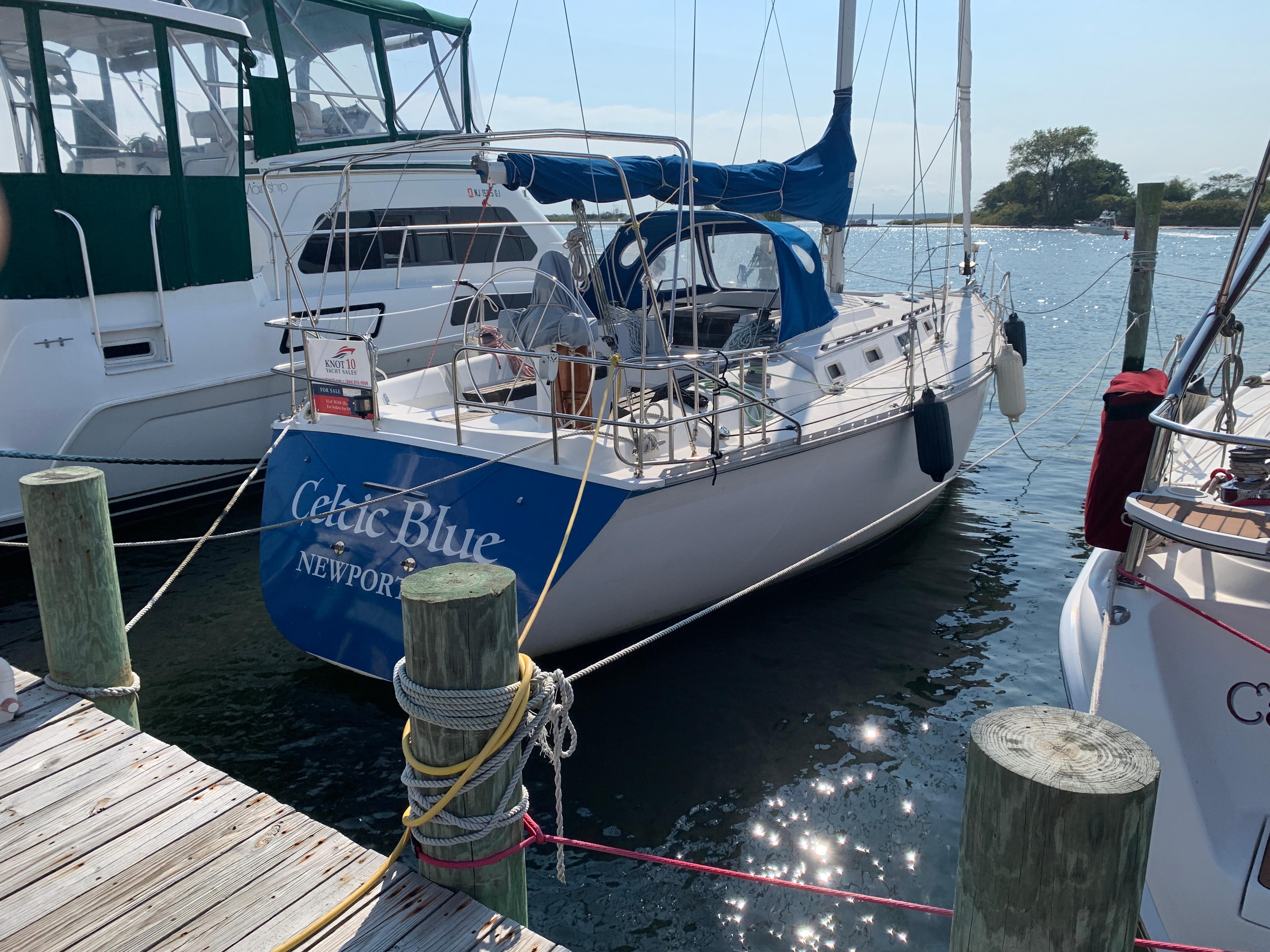
Hunter 40
Verified model photo · Photo source
Community photos are ranked by votes.Add your photo

At a glance

Length
39.63 ft↗
Beam
13.42 ft↗
Draft
  • Standard keel6.5 ft
  • Shoal keel5 ft
↗
Displacement
17,400 lb↗
Ballast
7,900 lb↗
Rig
Sloop↗
Built
1984–1990↗
Hull speed
7.64 kt
Headroom
6.5 ft↗

The quick verdict

The original Hunter 40 is an attractive budget cruiser for couples and families seeking generous accommodations without sacrificing sailing performance. Contemporary independent reviews are scarce, but experienced owners praise its speed and comfortable interior. Aging tankage, embedded chainplate anchors and original mechanical installations deserve particular scrutiny. A well-maintained example can offer excellent coastal cruising value, especially for buyers willing to undertake an older boat's maintenance.

Shopping for a boat like this?

Tell us how you'll sail and who's coming along. The Boat Picker asks a few quick questions and shows which boats fit your plans, so you can skip the guesswork.

Try the Boat Picker

All specifications

Production years
1984–1990↗
Designer
Cortland Steck↗

Dimensions & rating

Length overall
39.63 ft↗
Beam
13.42 ft↗
PHRF
103.1 (84–120)↗
Displacement
17,400 lb↗
Hull speed
7.64 kt
Standing headroom
6.5 ft↗
Draft by configuration↗
Standard keel6.5 ft
Shoal keel5 ft
Rudder type
Spade↗
Twin wheels
No↗
Rig type
Sloop↗
Mast step
Deck-stepped↗

Standardized sailing characteristics

Speed

PHRF 103

Lower PHRF means a faster racing handicap. Published configurations: 84–120. Rig, keel, and region affect ratings.

Reference source ↗

Comfort at Sea

Catalina 22 Mk IIPrecision 28Oceanis 37Catalina 30Island Packet 38Oyster 53
24.44

This boat's motion comfort ratio: a comparison of how gently a design moves at sea. A higher number is gentler. It does not rate cabin space or guarantee comfort.

Capsize screening (CSF)

Catalina 22 Mk IIPrecision 28Oceanis 37Catalina 30Island Packet 38Oyster 53
CSF 2.07

The Capsize Screening Formula: beam compared with displacement. A lower number means a boat is less prone to capsize, so the scale runs from least to most capable offshore; 2.0 or below is the usual guide. It is a screening figure, not a safety guarantee.

Measurements

Rig diagram & sailing measurements

Rig dimension reference
Rig measurement diagram showing I, ISP, J, P, E, PY and EY
General rig reference. PY and EY apply to boats with a mizzen mast.
CSF2.07
Above 2.0: generally does not meet the traditional offshore screening guideline (not a seaworthiness rating).
Rig dimension I (foretriangle height)53.75 ft↗
Rig dimension J (foretriangle base)17 ft↗
Rig dimension P (mainsail luff)48 ft↗
Rig dimension E (mainsail foot)13.75 ft↗
Forestay length56.37 ft
Sail area (base / working)787 sq ft↗
Mainsail area330 sq ft↗
Headsail / genoa area456.9 sq ft↗
Spinnaker / gennaker area776.7 sq ft↗
Air draft (clearance height)58.5 ft↗
Ballast / displacement ratio45.4
Hull speed7.64 kt

Construction

Construction

Hull material
Fiberglass ↗
Hull cored below waterline
No
Deck cored
Yes ↗
Deck core material
Plywood ↗
Structural grid / pan liner
Molded interior pan bonded to hull ↗
Keel type
Fin (deep) and shoal keel ↗
Keel material
Iron ↗
Keel attachment
Bolted ↗
Rudder type
Spade ↗
Number of rudders
1 ↗
Steering type
Wheel ↗
Twin wheels
No ↗
Fuel tank material
Aluminum ↗
Fresh water tank material
Aluminum ↗
Holding tank material
Integral fiberglass ↗

Construction & Equipment

Tankage

Fuel capacity
40 gal ↗
Holding tank capacity
26 gal ↗
Combined capacity calculated from two explicitly stated 13-gallon original integral holding tanks on the early 1985 configuration. The owner specifically notes that not all Hunter 40s used this arrangement. Later production boats used separate aluminum tanks.

Accommodation

Headroom (saloon)
6.5 ft ↗
Confirmed separately from draft in the factory specification table.

Full specifications

Figures link to the page they came from where one is published. Anything not shown is not yet confirmed by a published source.

Identity

Designer
Cortland Steck mauripro.com ↗
First year built
Last year built
Country built
United States mauripro.com ↗
Boat type
Sailing monohull seasailmakers.com ↗
Hull type
Monohull

Hull measurements

Length overall
39.63 ft sbo.sailboatowners.com ↗
Factory manual for the Legend 40, which is the same design as the Hunter 40. Other published figure: 39.58.
Waterline length
32.5 ft sbo.sailboatowners.com ↗
Legend 40 factory manual.
Beam (widest)
13.42 ft sbo.sailboatowners.com ↗
Legend 40 factory manual.
Draft (standard keel)
6.5 ft sbo.sailboatowners.com ↗
Deep fin keel.
Draft (alternate keel 1)
5 ft sbo.sailboatowners.com ↗
Shoal keel. Factory nominal draft.
Air draft (clearance height)
58.5 ft sbo.sailboatowners.com ↗
Factory mast height above design waterline. Allow additional clearance for masthead equipment and loading.
Hull speed
7.64 kt
Calculated: 1.34 x the square root of the waterline length (32.5 ft).
Displacement (light / design)
17,400 lb sbo.sailboatowners.com ↗
Deep keel configuration. Shoal keel configuration: 17900.
Ballast weight
7,900 lb sbo.sailboatowners.com ↗
Deep keel configuration. Shoal keel configuration: 8400.
Ballast material
Iron forums.sailboatowners.com ↗
Reported by an original-design Hunter 40 owner. Material of every keel configuration was not independently verified.
Ballast / displacement ratio
45.4
Calculated: ballast divided by displacement, using the published figures on this page.

Rig and sails

Rig type
Sloop mauripro.com ↗
Masthead B&R rig.
Number of masts
1 mauripro.com ↗
Single-masted configuration.
Mast material
Aluminium rigrite.com ↗
Rig-Rite identifies the Hunter 40 among the applications of the Isomat NG-70 mast section. 6061-T6 is an aluminium alloy. The mast identification is independently corroborated in a discussion concerning a 1987 Hunter Legend 40 at https://forums.sailboatowners.com/threads/whos-mast.1249940451/.
Mast stepping
Deck-stepped forums.sailboatowners.com ↗
Consistent with the factory Legend 40 compression-post construction detail.
Sail area (base / working)
787 sq ft sbo.sailboatowners.com ↗
Factory base sail area.
Rig dimension I (foretriangle height)
53.75 ft mauripro.com ↗
Agrees with factory manual.
Rig dimension J (foretriangle base)
17 ft mauripro.com ↗
Agrees with factory manual.
Rig dimension P (mainsail luff)
48 ft mauripro.com ↗
Agrees with factory manual.
Rig dimension E (mainsail foot)
13.75 ft mauripro.com ↗
Agrees with factory manual.
Mainsail area
330 sq ft en.wikipedia.org ↗
Published triangular mainsail reference area; actual roached cruising mainsail area can be larger.
Spinnaker / gennaker area
776.7 sq ft mauripro.com ↗
Cruising spinnaker reference area from a sail supplier. Not established as the largest factory-offered spinnaker.
Forestay length
56.37 ft
Calculated: the square root of (I squared + J squared), using the published rig dimensions on this page.
Headsail / genoa area
456.9 sq ft mauripro.com ↗
100 percent headsail reference area, not the area of the larger factory genoa.
Displacement / Length ratio
226.3
Calculated: (displacement in long tons) divided by (0.01 x waterline length) cubed, using the published figures on this page.
Capsize screening value
2.07
Calculated: beam divided by the cube root of (displacement in lb / 64), using the published beam and displacement on this page.
Motion comfort ratio (Brewer)
24.44
Calculated with Brewer's formula from this page's displacement, waterline length, overall length and beam.

Engine, propulsion, systems

Original engine make
Yanmar forums.sailboatowners.com ↗
Confirmed as original factory equipment.
Original engine model
4JHE forums.sailboatowners.com ↗
Confirmed by multiple original-design Hunter 40 owners. One digitized factory engine table renders the designation as 4JHSE, apparently a transcription error.
Fuel capacity
Original engine power
44 hp forums.sailboatowners.com ↗
44 hp one-hour rating; 40 hp continuous. The Hunter installation used a restricted exhaust configuration.
Fresh water capacity
100 gal
Also confirmed by the Hunter 40 Wikipedia article.
Holding tank capacity
26 gal forums.sailboatowners.com ↗
Combined capacity calculated from two explicitly stated 13-gallon original integral holding tanks on the early 1985 configuration. The owner specifically notes that not all Hunter 40s used this arrangement. Later production boats used separate aluminum tanks.

Accommodation

Cabins
2 en.wikipedia.org ↗
Two private sleeping cabins.
Heads (count, enclosed or not)
Navigation station
Yes forums.sailboatowners.com ↗
Aft-facing navigation station.
Headroom (saloon)
6.5 ft sbo.sailboatowners.com ↗
Confirmed separately from draft in the factory specification table.

Practical ownership

Known issues (sourced to magazines / associations)
Corrosion of embedded steel chainplate anchors and leakage from integral aft holding tanks. forums.sailboatowners.com ↗
Long-term owner describes chainplate anchor corrosion, sanitation tank problems and other maintenance concerns, particularly on early production boats. Other published figure: Corrosion beneath original aluminum fuel and freshwater tanks..
Strengths (sourced)
Good sailing performance, affordable acquisition cost and spacious accommodations. forums.sailboatowners.com ↗
Long-term owner also praises speed, affordability and the saloon and aft stateroom.
Owners' association link
legendowners.com legendowners.com ↗
Legend Owners Association includes the original Hunter 40 in its historical model catalogue.

Calculated from the figures above

Sail area / displacement ratio
18.75
Calculated: sail area divided by (displacement in lb / 64) to the power 2/3, using the published sail area and displacement above.
Pounds per inch of immersion (estimate)
1558.5
Estimated, not measured: waterline length x beam x 0.67 (typical waterplane coefficient) x 64 / 12, using the published figures above.

Hunter 40 problems

Reported by owners and reviewers. Condition varies from boat to boat.

  • Corrosion of embedded steel chainplate anchors and leakage from integral aft holding tanks ↗
  • Owners report good light-air sailing performance and reasonable value, making the Hunter 40 attractive for coastal cruising. ↗
  • Long-term owners identify corrosion of the embedded steel chainplate anchors as an important structural inspection point. ↗
  • A 1986 Hunter 40 owner repaired corrosion holes in the original fuel tank where moisture had accumulated around its supports. ↗
  • Owners report that the original restricted exhaust arrangement reduced the Yanmar 4JHE's available power. ↗
  • A 1985 Hunter 40 owner reports that reducing headsail area in moderate winds reduced excessive weather helm and increased boat speed. ↗
  • An early Hunter 40 owner repaired both integral holding tanks after the aft tank lid separated from the stringers and the forward tank developed a crack. ↗
  • An owner who sailed and chartered a Hunter Legend 40 for approximately five years in the Pacific Northwest considered it a good sailing boat. ↗
  • A 1986 Hunter 40 owner describes the boat as stable and unexpectedly quick under sail. ↗

Hunter 40 documents

Links to the builder's and other published documents.

What's on file

Nothing from owners yet. If you own one, you can add a survey or receipts in My boats and help the next buyer.

Surveys and Market Value

No surveys have been contributed for this boat yet.

Up to 2 per boat, PDF under 4 MB (larger ones: add them from My boats). This can take up to a minute.

Watch the boat

Top Five 40 Foot Sailboats - Ep 213 - Lady K Sailing

Watch on YouTube ↗

Community contributions or corrections

Do you have information about this boat, a photo of it, or advice for future owners? Leave a comment below regarding this make and model. For corrections, leave the corrected information with the source so we can investigate and update the boat wiki page.

Sign in

Comments

No comments yet.