Hunter 30 Cherubin

Hunter Marine

Hunter 30 Cherubin is a 29.96 ft sloop sailboat built by Hunter Marine and designed by John Cherubini, first produced in 1973. It has displacement of 9,700 lb, a hull speed of 6.8 kt and a fin (deep), fin (shoal),/centerboard keel.
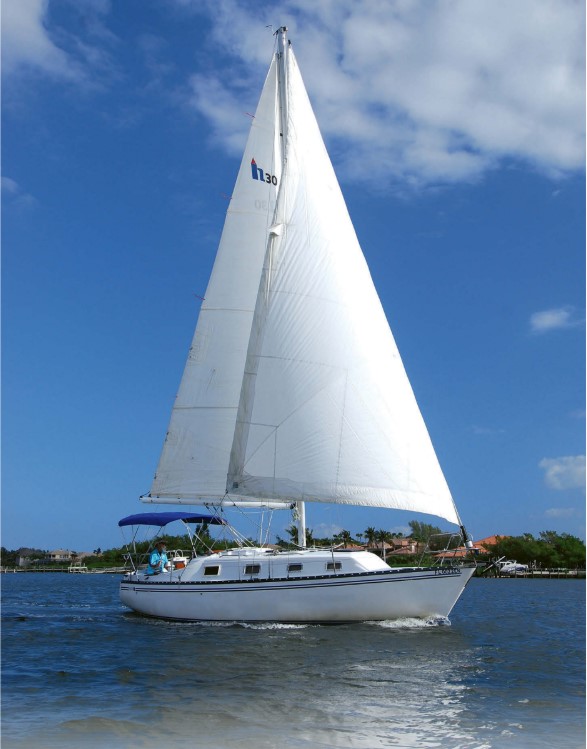
Hunter 30 Cherubin
Good Old Boat · Photo source
Community photos are ranked by votes.Add your photo

At a glance

Length
29.96 ft↗
Beam
10.17 ft↗
Draft
  • Standard keel5.25 ft
  • Shoal fin keel4 ft
↗↗
Displacement
9,700 lb↗
Ballast
4,000 lb↗
Rig
Sloop↗
Built
1973–1983↗
Hull speed
6.8 kt
Headroom
6.33 ft↗

The quick verdict

The Cherubini Hunter 30 suits budget-conscious sailors looking for a conventional coastal cruiser with enough accommodation for weekends and family vacations. Its principal strengths are useful interior space, responsive handling and straightforward construction. Its biggest weakness is the potential for age-related structural deterioration, particularly around the mast compression support and cored deck. Buy on condition rather than price alone.

Shopping for a boat like this?

Tell us how you'll sail and who's coming along. The Boat Picker asks a few quick questions and shows which boats fit your plans, so you can skip the guesswork.

Try the Boat Picker

All specifications

Production years
1973–1983↗
Designer
John Cherubini↗

Dimensions & rating

Length overall
29.96 ft↗
Beam
10.17 ft↗
PHRF
186↗
Displacement
9,700 lb↗
Hull speed
6.8 kt
Standing headroom
6.33 ft↗
Draft by configuration↗↗
Standard keel5.25 ft
Shoal fin keel4 ft
Rudder type
Skeg-hung↗
Twin wheels
No↗
Rig type
Sloop↗
Mast step
Deck-stepped↗

Standardized sailing characteristics

Speed

PHRF 186

Lower PHRF means a faster racing handicap. Rig, keel, and region affect ratings.

Reference source ↗

Comfort at Sea

Catalina 22 Mk IIPrecision 28Oceanis 37Catalina 30Island Packet 38Oyster 53
25.27

This boat's motion comfort ratio: a comparison of how gently a design moves at sea. A higher number is gentler. It does not rate cabin space or guarantee comfort.

Capsize screening (CSF)

Catalina 22 Mk IIPrecision 28Oceanis 37Catalina 30Island Packet 38Oyster 53
CSF 1.91

The Capsize Screening Formula: beam compared with displacement. A lower number means a boat is less prone to capsize, so the scale runs from least to most capable offshore; 2.0 or below is the usual guide. It is a screening figure, not a safety guarantee.

Measurements

Rig diagram & sailing measurements

Rig dimension reference
Rig measurement diagram showing I, ISP, J, P, E, PY and EY
General rig reference. PY and EY apply to boats with a mizzen mast.
CSF1.91
Below 2.0: generally meets the traditional offshore screening guideline (not a seaworthiness rating).
Rig dimension I (foretriangle height)40 ft↗
Rig dimension J (foretriangle base)12.83 ft↗
Rig dimension P (mainsail luff)34.2 ft↗
Rig dimension E (mainsail foot)11.5 ft↗
Forestay length42.01 ft
Sail area (base / working)453.25 sq ft
Mainsail area197 sq ft↗
Headsail / genoa area256.6 sq ft↗
Spinnaker / gennaker area436.2 sq ft↗
Air draft (clearance height)47 ft↗
Ballast / displacement ratio41.2
Hull speed6.8 kt

Construction

Construction

Hull material
Fiberglass ↗
Hull cored below waterline
No ↗
Hull cored above waterline
No ↗
Hull core material
None ↗
Deck cored
Yes ↗
Deck core material
Balsa and plywood ↗
Hull-to-deck joint
Inward flange ↗
Keel type
Fin (deep), fin (shoal), keel/centerboard ↗
Keel material
Lead ↗
Keel attachment
Bolted ↗
Rudder type
Skeg-hung ↗
Number of rudders
1 ↗
Twin wheels
No ↗
Steering type
Wheel ↗
Fuel tank material
Aluminium ↗

Construction & Equipment

Tankage

Fuel capacity
12 gal ↗
The HunterOwners specification search result reports 12.5 gallons, but its full page could not be opened.
Fresh water capacity
33 gal ↗
Alternative published figure: 35.
Holding tank capacity
5 gal ↗
Described in the model review. Original factory capacity for every production year is not independently established.

Accommodation

Headroom (saloon)
6.33 ft ↗
Factory maximum headroom. Other published figure: 6.

Full specifications

Figures link to the page they came from where one is published. Anything not shown is not yet confirmed by a published source.

Identity

Designer
John Cherubini mauripro.com ↗
Original Cherubini design.
First year built
1973 precisionsailloft.com ↗
Other published figure: 1974.
Last year built
Number built
1,000 practical-sailor.com ↗
Published approximate production count, not an exact confirmed factory total. Some hulls were supplied as Quest 30 unfinished kits.
Country built
United States goodoldboat.com ↗
Boat type
Sailing monohull en.wikipedia.org ↗
Conventional single-hull sailing cruiser.
Hull type
Monohull

Hull measurements

Length overall
29.96 ft sbo.sailboatowners.com ↗
Original Hunter specification. Practical Sailor corroborates a length of approximately 29 feet 11 inches.
Waterline length
25.75 ft goodoldboat.com ↗
Both standard and tall rigs share the same hull.
Beam (widest)
Draft (standard keel)
5.25 ft practical-sailor.com ↗
Deep fin keel. Standard factory configuration.
Draft (alternate keel 1)
4 ft goodoldboat.com ↗
Shoal fin keel. Also corroborated by Practical Sailor and original Hunter literature. Shoal fin keel: 4.3.
Air draft (clearance height)
47 ft sbo.sailboatowners.com ↗
Tall-rig factory mast height above waterline. Allow additional clearance for masthead equipment.
Hull speed
6.8 kt
Calculated: 1.34 x the square root of the waterline length (25.75 ft).
Displacement (light / design)
9,700 lb goodoldboat.com ↗
Published production displacement. Other published figure: 10002.
Ballast weight
4,000 lb sbo.sailboatowners.com ↗
Original Hunter literature specifies 4000 pounds for both deep and shoal keels.
Ballast material
Lead goodoldboat.com ↗
Confirmed independently by Hunter owners.
Ballast / displacement ratio
41.2
Calculated: ballast divided by displacement, using the published figures on this page.

Rig and sails

Rig type
Sloop mauripro.com ↗
Standard and tall masthead rigs.
Rig options offered
Standard masthead rig and tall masthead rig goodoldboat.com ↗
Tall rig: 42/12.83/37/10.7 feet. These are rig configurations, not separate named production marks.
Number of masts
1 mauripro.com ↗
Single-mast configuration.
Mast material
Mast stepping
Deck-stepped goodoldboat.com ↗
Sail area (base / working)
453.25 sq ft
Standard rig, calculated using the published rig dimensions. Factory-published tall-rig sail area: 473.1.
Rig dimension I (foretriangle height)
40 ft precisionsailloft.com ↗
Standard rig.
Rig dimension J (foretriangle base)
12.83 ft precisionsailloft.com ↗
Shared by standard and tall rigs.
Rig dimension P (mainsail luff)
34.2 ft precisionsailloft.com ↗
Standard rig. Tall rig P is 37 feet.
Rig dimension E (mainsail foot)
11.5 ft precisionsailloft.com ↗
Standard rig. Tall rig E is approximately 10.7 to 10.75 feet.
Mainsail area
197 sq ft goodoldboat.com ↗
Standard rig.
Forestay length
42.01 ft
Calculated: the square root of (I squared + J squared), using the published rig dimensions on this page.
Spinnaker / gennaker area
436.2 sq ft mauripro.com ↗
Cruising spinnaker, sail supplier specification. Largest factory-offered spinnaker size was not established.
Headsail / genoa area
256.6 sq ft mauripro.com ↗
100 percent headsail area for the standard rig.
Displacement / Length ratio
253.6
Calculated: (displacement in long tons) divided by (0.01 x waterline length) cubed, using the published figures on this page.
Capsize screening value
1.91
Calculated: beam divided by the cube root of (displacement in lb / 64), using the published beam and displacement on this page.
Motion comfort ratio (Brewer)
25.27
Calculated with Brewer's formula from this page's displacement, waterline length, overall length and beam.

Engine, propulsion, systems

Original engine make
Yanmar practical-sailor.com ↗
Larger Yanmar diesels were introduced during production.
Original engine model
YSM12 forums.sailboatowners.com ↗
Confirmed by the owner as original equipment on a 1978 Cherubini Hunter 30. Later boats received larger engines.
Fuel capacity
12 gal goodoldboat.com ↗
The HunterOwners specification search result reports 12.5 gallons, but its full page could not be opened.
Original engine power
12 hp practical-sailor.com ↗
Standard early-production engine. Introduced after 1978: 15. Later production engine: 18.
Fresh water capacity
33 gal goodoldboat.com ↗
Alternative published figure: 35.
Holding tank capacity
5 gal goodoldboat.com ↗
Described in the model review. Original factory capacity for every production year is not independently established.

Accommodation

Heads (count, enclosed or not)
1 sbo.sailboatowners.com ↗
Single enclosed head with shower.
Navigation station
Yes practical-sailor.com ↗
Located at the head of the quarter berth.
Headroom (saloon)
6.33 ft sbo.sailboatowners.com ↗
Factory maximum headroom. Other published figure: 6.

Practical ownership

Known issues (sourced to magazines / associations)
Mast-step moisture intrusion, deck-core deterioration, corrosion of the steel compression-post foundation, leaking ports, cockpit delamination, aging fuel tanks and restricted engine access. goodoldboat.com ↗
Inspect the mast support beneath the cabin sole particularly carefully. Additional construction and equipment concerns are documented in Practical Sailor's Hunter 30 reviews.
Strengths (sourced)
Affordable coastal cruising, spacious accommodations, responsive sailing characteristics, conventional rig and straightforward fiberglass construction. practical-sailor.com ↗
Well suited to economical recreational sailing when maintained appropriately.
Owners' association link
hunter.sailboatowners.com hunter.sailboatowners.com ↗
HunterOwners.com model-specific owner resources, manuals and discussion community.

Calculated from the figures above

Sail area / displacement ratio
15.94
Calculated: sail area divided by (displacement in lb / 64) to the power 2/3, using the published sail area and displacement above.
Pounds per inch of immersion (estimate)
935.8
Estimated, not measured: waterline length x beam x 0.67 (typical waterplane coefficient) x 64 / 12, using the published figures above.

Hunter 30 Cherubin problems

Reported by owners and reviewers. Condition varies from boat to boat.

  • Mast-step moisture intrusion, deck-core deterioration, corrosion of the steel compression-post foundation, leaking ports, cockpit delamination, aging fuel tanks and restricted engine access ↗
  • A 1979 Hunter 30 owner successfully lived aboard with his wife for a year by converting the pilot berth into additional storage. ↗
  • A 1983 Hunter 30 owner encountered substantial corrosion at the mast compression-post foundation in the bilge. ↗
  • An owner of a 1980 Hunter 30 rebuilt the mast compression support and found severe deterioration of the plywood chainplate supports. ↗

What the magazines say

Owner experiences and professional commentary are separate sources. Condition varies from boat to boat.

  • Practical Sailor found the original Hunter 30 responsive under sail and competitive with comparable production cruisers of its era. Read source
  • Good Old Boat's sailing test found that the Hunter 30 was less effective in light winds but accelerated readily as wind strength increased. Read source
  • Practical Sailor identifies interior volume relative to purchase price as a major reason owners selected the original Hunter 30. Read source
  • Practical Sailor's retrospective documented Hunter 30s serving successfully as affordable homes and undertaking extended Caribbean cruising. Read source

Hunter 30 Cherubin documents

Links to the builder's and other published documents.

What's on file

Nothing from owners yet. If you own one, you can add a survey or receipts in My boats and help the next buyer.

Surveys and Market Value

No surveys have been contributed for this boat yet.

Up to 2 per boat, PDF under 4 MB (larger ones: add them from My boats). This can take up to a minute.

Community contributions or corrections

Do you have information about this boat, a photo of it, or advice for future owners? Leave a comment below regarding this make and model. For corrections, leave the corrected information with the source so we can investigate and update the boat wiki page.

Sign in

Comments

No comments yet.