Hunter 216

Hunter Marine

Hunter 216 is a 21.5 ft sloop sailboat built by Hunter Marine and designed by Glenn Henderson, first produced in 2003. It has displacement of 1,500 lb, a hull speed of 5.8 kt and a centerboard keel.
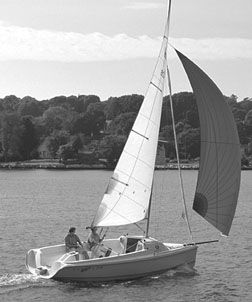
Hunter 216
Practical Sailor · Photo source
Community photos are ranked by votes.Add your photo

At a glance

Length
21.5 ft↗
Beam
7.92 ft↗
Draft
  • Standard keel3.5 ft
  • Centerboard raised1 ft
↗
Displacement
1,500 lb↗
Ballast
500 lb↗
Rig
Sloop↗
Built
2003
Hull speed
5.8 kt

The quick verdict

The Hunter 216 suits sailors seeking a lively, easily transported daysailer with enough cockpit space for family and friends. Its hydraulic lifting keel, straightforward rig and responsive sailing characteristics make it particularly attractive for lake sailing and club racing. The unusual ACP thermoplastic construction is its greatest purchasing concern, with some owners reporting cracking after winter storage. Buy on condition, paying particular attention to the hull, keel mechanism and lifting rudder.

Shopping for a boat like this?

Tell us how you'll sail and who's coming along. The Boat Picker asks a few quick questions and shows which boats fit your plans, so you can skip the guesswork.

Try the Boat Picker

All specifications

Production years
2003
Designer
Glenn Henderson↗

Dimensions & rating

Length overall
21.5 ft↗
Beam
7.92 ft↗
PHRF
214.5 (198–231)↗
Displacement
1,500 lb↗
Hull speed
5.8 kt
Draft by configuration↗
Standard keel3.5 ft
Centerboard raised1 ft
Rudder type
Spade↗
Twin wheels
No↗
Rig type
Sloop↗
Mast step
Keel-stepped↗

Standardized sailing characteristics

Speed

PHRF 215

Lower PHRF means a faster racing handicap. Published configurations: 198–231. Rig, keel, and region affect ratings.

Reference source ↗

Comfort at Sea

Catalina 22 Mk IIPrecision 28Oceanis 37Catalina 30Island Packet 38Oyster 53
6.27

This boat's motion comfort ratio: a comparison of how gently a design moves at sea. A higher number is gentler. It does not rate cabin space or guarantee comfort.

Capsize screening (CSF)

Catalina 22 Mk IIPrecision 28Oceanis 37Catalina 30Island Packet 38Oyster 53
CSF 2.94

The Capsize Screening Formula: beam compared with displacement. A lower number means a boat is less prone to capsize, so the scale runs from least to most capable offshore; 2.0 or below is the usual guide. It is a screening figure, not a safety guarantee.

Measurements

Rig diagram & sailing measurements

Rig dimension reference
Rig measurement diagram showing I, ISP, J, P, E, PY and EY
General rig reference. PY and EY apply to boats with a mizzen mast.
CSF2.94
Above 2.0: generally does not meet the traditional offshore screening guideline (not a seaworthiness rating).
Rig dimension I (foretriangle height)21.92 ft↗
Rig dimension J (foretriangle base)7.33 ft↗
Rig dimension P (mainsail luff)24.58 ft↗
Rig dimension E (mainsail foot)10.42 ft↗
Forestay length22.97 ft↗
Sail area (base / working)252 sq ft↗
Mainsail area128.1 sq ft
Headsail / genoa area80.3 sq ft↗
Spinnaker / gennaker area200 sq ft↗
Air draft (clearance height)30.92 ft
Ballast / displacement ratio33.3
Hull speed5.8 kt

Construction

Construction

Hull material
Thermoplastic composite ↗
Hull cored below waterline
Yes ↗
Hull cored above waterline
Yes ↗
Hull core material
Foam ↗
Keel type
Centerboard ↗
Keel material
Lead ↗
Rudder type
Spade ↗
Number of rudders
1 ↗
Twin wheels
No ↗
Steering type
Tiller ↗

Full specifications

Figures link to the page they came from where one is published. Anything not shown is not yet confirmed by a published source.

Identity

Designer
Glenn Henderson mauripro.com ↗
Also confirmed by Practical Sailor.
First year built
2003
Number built
250 en.wikipedia.org ↗
Practical Sailor reported more than 200 sales during the first year, but an independent final factory production count was not located.
Country built
United States practical-sailor.com ↗
The original model was manufactured in the United States.
Boat type
Sailing monohull en.wikipedia.org ↗
Trailerable monohull daysailer.
Hull type
Monohull

Hull measurements

Length overall
Waterline length
18.75 ft
Beam (widest)
7.92 ft hunter.sailboatowners.com ↗
Matches the builder's manual.
Draft (standard keel)
3.5 ft sbo.sailboatowners.com ↗
Hydraulically operated swing keel, fully lowered.
Draft (alternate keel 1)
1 ft sbo.sailboatowners.com ↗
Centerboard raised. This is the retracted position of the standard ballasted swing keel, not a separate keel option.
Draft with board / keel / daggerboards raised
1 ft sbo.sailboatowners.com ↗
The ballasted centerboard remains partially exposed when fully raised.
Air draft (clearance height)
30.92 ft
Hunter's manual confirms a mast height of 30 ft 11 in. Allow additional clearance for masthead equipment.
Hull speed
5.8 kt
Calculated: 1.34 x the square root of the waterline length (18.75 ft).
Displacement (light / design)
1,500 lb sbo.sailboatowners.com ↗
Original manufacturer manual figure. The loading condition is not specified. Other published figure: 1350. Other published figure: 1250.
Ballast weight
500 lb hunter.sailboatowners.com ↗
Ballast is carried in the hydraulically retractable keel.
Ballast material
Ballast / displacement ratio
33.3
Calculated: ballast divided by displacement, using the published figures on this page.

Rig and sails

Rig type
Sloop mauripro.com ↗
Fractional rig.
Rig options offered
Optional asymmetric spinnaker and retractable bowsprit practical-sailor.com ↗
Optional performance sail package. No separate factory tall or short mast version was verified.
Number of masts
1 mauripro.com ↗
Single-masted fractional sloop.
Mast stepping
Keel-stepped practical-sailor.com ↗
The mast passes into the cuddy cabin and is supported below deck.
Sail area (base / working)
252 sq ft sbo.sailboatowners.com ↗
Manufacturer's reported working sail area. Other published figure: 218.6.
Rig dimension I (foretriangle height)
Rig dimension J (foretriangle base)
Rig dimension P (mainsail luff)
Rig dimension E (mainsail foot)
Mainsail area
128.1 sq ft
Calculated: half of P x E (24.58 x 10.42 ft), using the published rig dimensions on this page.
Forestay length
22.97 ft pacificsailors.com ↗
Builder-stated optional conventional forestay length, pin to pin, fork to turnbuckle half open. The standard arrangement integrates the forestay into the jib luff. This is not an estimated measurement.
Spinnaker / gennaker area
200 sq ft en.wikipedia.org ↗
Optional factory asymmetric spinnaker. The original brochure cited by Wikipedia could not be retrieved to independently confirm the area.
Headsail / genoa area
80.3 sq ft mauripro.com ↗
100 percent foretriangle reference area. Not necessarily the actual area of the original overlapping jib.
Displacement / Length ratio
101.6
Calculated: (displacement in long tons) divided by (0.01 x waterline length) cubed, using the published figures on this page.
Capsize screening value
2.94
Motion comfort ratio (Brewer)
6.27

Accommodation

Cabins
1 forums.sailboatowners.com ↗
Single small cuddy cabin, primarily useful for storage and occasional shelter.

Practical ownership

Known issues (sourced to magazines / associations)
Thermoplastic skin cracking, particularly following cold-weather exposure. forums.sailboatowners.com ↗
Owners report that some boats are affected while others remain crack-free. Inspect the extent and location of cracking rather than assuming every crack is cosmetic. Other published figure: Water ingress into the cuddy around the mast opening..
Strengths (sourced)
Responsive light-air sailing, easy singlehanded operation and minimal setup time. hunter.sailboatowners.com ↗
Other published figure: Spacious cockpit, shallow-water access and trailerability..
Owners' association link
pacificsailors.com pacificsailors.com ↗
General Hunter owners community with archived Hunter 216 manufacturer documentation. No dedicated Hunter 216 class association was verified.

Calculated from the figures above

Sail area / displacement ratio
30.77
Calculated: sail area divided by (displacement in lb / 64) to the power 2/3, using the published sail area and displacement above.
Pounds per inch of immersion (estimate)
530.6
Estimated, not measured: waterline length x beam x 0.67 (typical waterplane coefficient) x 64 / 12, using the published figures above.

Hunter 216 problems

Reported by owners and reviewers. Condition varies from boat to boat.

  • Thermoplastic skin cracking, particularly following cold-weather exposure ↗
  • Responsive light-air sailing, easy singlehanded operation and minimal setup time. ↗

Hunter 216 documents

Links to the builder's and other published documents.

What's on file

Nothing from owners yet. If you own one, you can add a survey or receipts in My boats and help the next buyer.

Surveys and Market Value

No surveys have been contributed for this boat yet.

Up to 2 per boat, PDF under 4 MB (larger ones: add them from My boats). This can take up to a minute.

Community contributions or corrections

Do you have information about this boat, a photo of it, or advice for future owners? Leave a comment below regarding this make and model. For corrections, leave the corrected information with the source so we can investigate and update the boat wiki page.

Sign in

Comments

No comments yet.