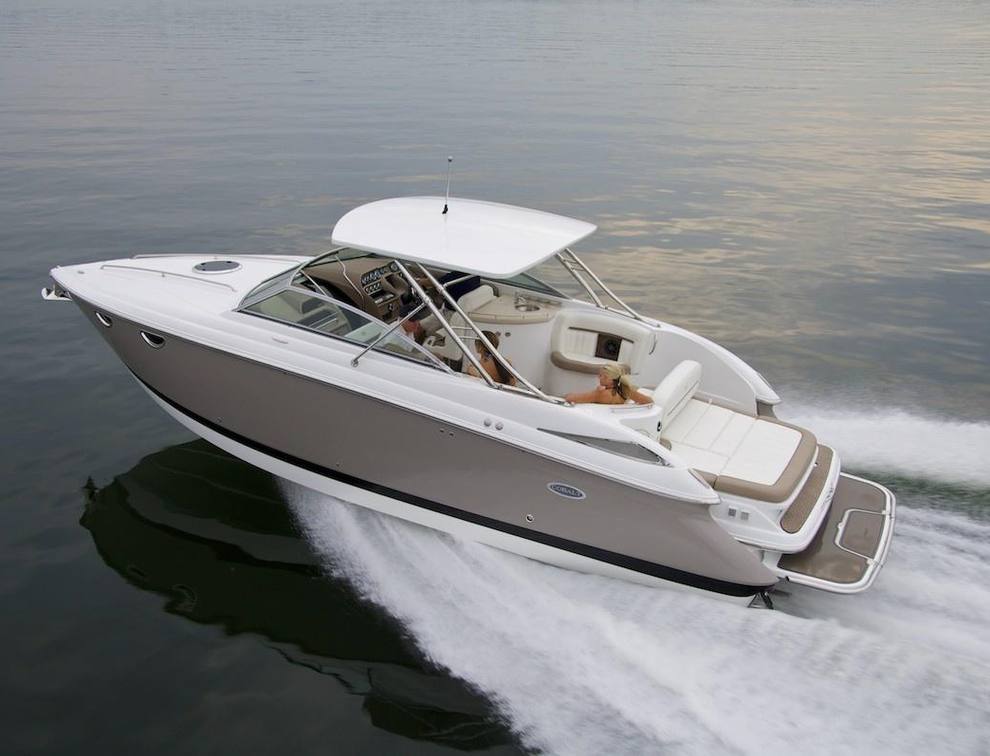
Figures link to the page they came from where one is published. Anything not shown is not yet confirmed by a published source.
Identity
First year built
2006
hmy.com ↗Powerboat Guide identifies 2006 as the first production year. Cobalt's official owners archive also contains a 2006 Model 323 manual.
Last year built
2013
hmy.com ↗Powerboat Guide identifies a 2006–2013 production span, also reported by YachtBuyer. However, Cobalt's official owner-manual archive lists a 2015 Model 323 manual and other sources report an end in 2015. The final hull-production year is therefore disputed.
Country built
United States
itboat.com ↗The independent Cobalt 323 review identifies the Cobalt factory in Neodesha, Kansas, USA, where the brand's boats were built.
Boat type
Express cruiser
boattest.com ↗BoatTEST classification. Cobalt calls the model a Day Cruiser, while Powerboat Guide describes it as a luxury-class cuddy cruiser. It has an enclosed forward cabin, galley and head.
Hull measurements
Length overall
34.75 ft
cobaltboats.com ↗Builder specifies 34 feet 9 inches including the swim platform, converted to 34.75 feet. The same manual gives 32 feet 10 inches, or 32.833 feet, without the swim platform.
Beam (widest)
10.58 ft
cobaltboats.com ↗Builder's 10-foot-7-inch specification, converted to feet. The manufacturer figure takes priority. Powerboat Guide reports 10 feet 6 inches: 10.5.
Engine, propulsion, systems
Original engine make
MerCruiser
cobaltboats.com ↗Factory gasoline engine manufacturer. The original Cobalt propeller chart lists multiple MerCruiser configurations. Other published figure: Volvo Penta.
Original engine model
350 MAG MPI
cobaltboats.com ↗MerCruiser 300-hp gasoline engine. MerCruiser 320-hp gasoline engine: 6.2 MX MPI. MerCruiser 375-hp gasoline engine: 496 MAG MPI. MerCruiser 425-hp gasoline engine: 496 MAG HO MPI. Volvo Penta 320-hp gasoline engine: 5.7 GXi. Volvo Penta 375-hp gasoline engine: 8.1 Gi.
Accommodation
Cabins
1
itboat.com ↗Single forward cuddy cabin with convertible V-shaped lounge/berth. The reviewer describes it as a cuddy layout rather than a multi-stateroom cruiser.
Heads (count, enclosed or not)
1
cobaltboats.com ↗One standard enclosed head with shower. The 2009 factory standard-equipment list also specifies a VacuFlush head; a macerator arrangement was optional.
Practical ownership
Known issues (sourced to magazines / associations)
Helm VHF radio location can interfere with the driver's knee.
web.archive.org ↗BoatTEST captain's report. Equipment-position criticism applies to the reviewed installation, not a demonstrated structural defect. Other published figure: Some chartplotter-equipped helm layouts omit the separate magnetic compass..
Strengths (sourced)
Kevlar-reinforced fiberglass hull with substantial structural reinforcement and excellent perceived solidity.
itboat.com ↗Independent YACHTS magazine review reproduced by itBoat praises construction solidity and low noise at speed. Other published figure: Comfortable deep-V ride, strong acceleration and responsive handling..
Hull
How the hull moves through the water
Planing
canadianboating.ca ↗Deep-V planing hull with 22 degrees of transom deadrise. The quoted acceleration was achieved with twin 400-hp Volvo Penta 8.1 GiCE-Q engines.
Number of hulls
1
hmy.com ↗Conventional single-hull deep-V cruiser, not a multihull.
Size
What the overall length includes
Includes extended swim platform
cobaltboats.com ↗The 34.75-foot LOA includes the extended swim platform. Cobalt separately publishes a 32.833-foot measurement without it. The difference is measurement basis, not a different hull.
Draft with the drive or stabilisers down
2.92 ft
cobaltboats.com ↗Builder's 35-inch draft converted to feet. Specifically measured with the sterndrive legs lowered.
Draft with the drive up
2 ft
cobaltboats.com ↗Manufacturer's 24-inch draft, converted to 2 feet, with the sterndrive legs raised.
Air draft (mast and bridge up)
8.83 ft
cobaltboats.com ↗Builder's bridge clearance with optional arch, 8 feet 10 inches, converted to 8.833 feet. The same manual lists 6 feet 5 inches without the Bimini. It does not establish clearance for every possible hardtop or antenna arrangement.
Weight
Dry weight
12,300 lb
cobaltboats.com ↗Cobalt's published dry weight is 12,300 pounds. Optional equipment affects weight. The manual does not explicitly define whether engines are included; fuel inclusion is also not separately specified. Other published figure: 12500.
Engines
Number of engines
2
cobaltboats.com ↗Factory twin-engine configuration. The propeller application chart includes multiple twin MerCruiser and Volvo Penta options.
Horsepower of each engine
300 hp
cobaltboats.com ↗Each MerCruiser 350 MAG gasoline engine, with Bravo III sterndrive. Listed in the factory propeller application chart. Other published figure: 320. Other published figure: 375. Other published figure: 375. Other published figure: 425. Each Volvo Penta D4 diesel engine: 260.
Fuel type
Gasoline
cobaltboats.com ↗Factory gasoline MerCruiser and Volvo Penta engine configurations were available. Other published figure: Diesel.
Drive type
Sterndrive
cobaltboats.com ↗Factory inboard-outboard propulsion. MerCruiser Bravo and Volvo Penta Duoprop sterndrives were documented, including some XDP configurations.
Where the engines sit
Aft engine compartment beneath the rear sun pad
web.archive.org ↗Twin engines are accessed beneath the rear sun lounge through an electrically actuated motor-box hatch.
Tanks
Fuel capacity
174 gal
cobaltboats.com ↗Builder's published total capacity in US gallons. The usable portion is not separately stated. The same figure appears in the 2011 manual and Canadian Boating test. Powerboat Guide lists 154 gallons: 154.
Fresh water capacity
18 gal
cobaltboats.com ↗18 US gallons. Independently confirmed by Canadian Boating and Powerboat Guide.
Waste (holding) capacity
28 gal
cobaltboats.com ↗28 US gallons. Independently confirmed by Canadian Boating and Powerboat Guide.
Performance
Cruising speed
29.72 kn
web.archive.org ↗34.2 statute mph converted to 29.72 knots. BoatTEST test with twin 375-hp Volvo Penta 8.1 Gi Duoprop sterndrives, four people aboard, 80% fuel, no water, and 13,835-pound tested weight.
Top speed
47.01 kn
web.archive.org ↗BoatTEST 54.1 statute mph converted to 47.01 knots. Twin 375-hp Volvo Penta 8.1 Gi engines. Four people, 80% fuel, no freshwater, tested weight 13,835 pounds.
Range
211.16 nm
web.archive.org ↗BoatTEST's published 243 statute miles converted to 211.16 nautical miles, at 34.2 mph or 29.72 knots. Twin 375-hp Volvo Penta 8.1 Gi engines. Test load: four people, 80% fuel, empty freshwater tank, 13,835 pounds. The published range includes a 10% fuel reserve, rather than using the entire tank.
Speed the range was quoted at
29.72 kn
web.archive.org ↗Range calculation speed quoted by BoatTEST. 34.2 statute mph converted to 29.72 knots. Twin 375-hp Volvo Penta 8.1 Gi engines; same test as the published 243-mile range.
Fuel burn at cruise
22 gal/hr
web.archive.org ↗Combined fuel consumption of both twin 375-hp Volvo Penta 8.1 Gi engines at 34.2 mph, or 29.72 knots, and 3,000 rpm. BoatTEST load was four people, 80% fuel, no freshwater and 13,835 pounds tested.
Fuel efficiency
1.35 nm/gal
web.archive.org ↗BoatTEST directly publishes 1.55 statute miles per US gallon at 34.2 mph. Converted using 1 statute mile = 0.868976 nautical miles, giving 1.347 nautical miles per US gallon at 29.72 knots. Twin 375-hp Volvo Penta 8.1 Gi engines, same test as the cruising speed, fuel burn and range.
Engine size used in the speed test
375 hp
web.archive.org ↗Each engine rated 375 horsepower. This exact twin-engine configuration was used for all selected BoatTEST speed, range, fuel-burn and efficiency figures. Test weight was 13,835 pounds with four people, 80% fuel and no freshwater.
Speed the fuel figures were measured at
29.72 kn
web.archive.org ↗Speed corresponding to the 22-US-gallon-per-hour combined fuel burn and 1.55-statute-mpg efficiency. Converted from 34.2 mph to 29.72 knots. Twin 375-hp Volvo Penta 8.1 Gi engines.