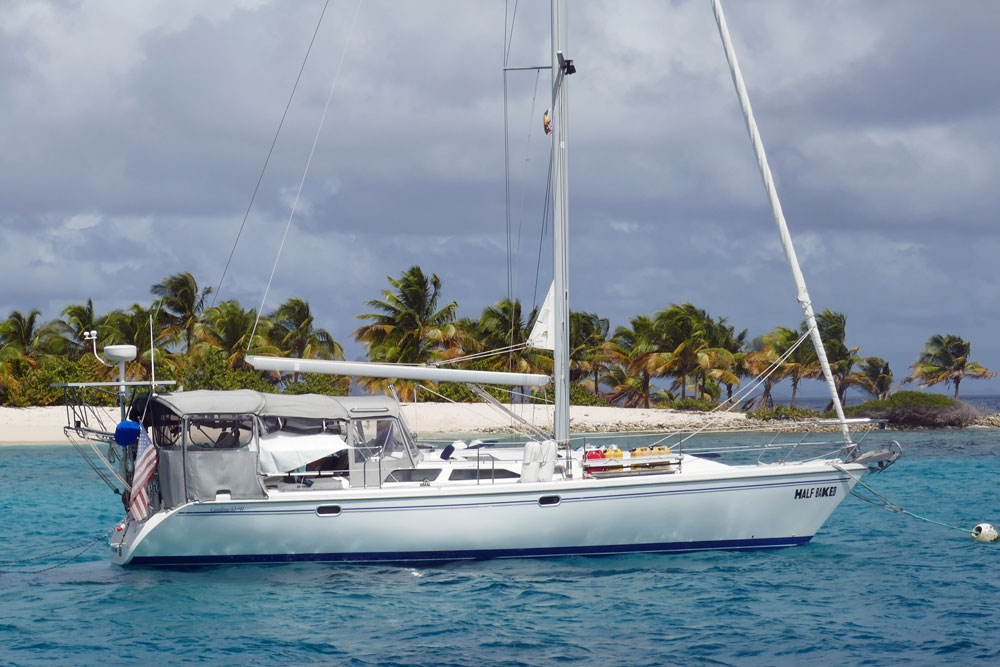
Figures link to the page they came from where one is published. Anything not shown is not yet confirmed by a published source.
Identity
Designer
Gerry Douglas
spinsheet.com ↗Catalina's in-house design team developed the Catalina 42.
Last year built
2011
practical-sailor.com ↗Practical Sailor identifies February 1995 as the introduction of the Mk II and 2011 as its discontinuation.
Country built
United States
spinsheet.com ↗Catalina Yachts also describes its boats as built in America on its official association page.
Hull measurements
Length overall
43.17 ft
catalinayachts.com ↗Builder's stated length overall. The same brochure separately identifies the length of hull as 41 ft 10 in.
Length on deck
41.83 ft
catalinayachts.com ↗Builder labels this measurement 'Length of Hull,' rather than explicitly 'length on deck.' Included as the nearest stated hull-length measurement; do not confuse with the builder's 43 ft 2 in LOA.
Draft (alternate keel 1: shoal / wing / centerboard up)
4.83 ft
catalinayachts.com ↗Shoal-draft wing keel. WaveTrain independently identifies the 4 ft 10 in wing-keel option.
Air draft (clearance height)
58.58 ft
catalinayachts.com ↗Builder labels this measurement 'Waterline to Masthead.' Antennas, wind instruments and other fittings above the masthead may increase actual bridge clearance.
Displacement (light / design)
20,500 lb
catalinayachts.com ↗Builder's approximate basic weight for both fin- and wing-keel configurations. Another source gives 22500 (www.spinsheet.com: The reviewer reports that actual displacement is closer to 22,500 lb than the advertised basic weight. WaveTrain also publishes 22,500 lb. This is not the same measurement ba
Ballast weight
8,300 lb
catalinayachts.com ↗Builder specifies the same ballast weight for fin and wing keels; confirmed by Practical Sailor and WaveTrain.
Rig and sails
Rig type
Sloop
sailingmagazine.net ↗Masthead sloop, corroborated by the Catalina 42 Mk II specification page at Sailboat Cruising.
Rig options offered
Full-batten mainsail with Dutchman system standard; optional mast or boom furling.
catalinayachts.com ↗Builder describes sail-handling alternatives, not separate mast-height or rig-design marks.
Mast material
Aluminium
practical-sailor.com ↗Practical Sailor identifies the anodized Isomat mast with double swept spreaders.
Mast stepping
Keel-stepped
tapatalk.com ↗Catalina 4 Series Association owners describe water entering the bilge down the keel-stepped mast. A separate association discussion corroborates this arrangement. Source could not be opened by the site (blocked, a picture of a brochure, or a very large file); the quote was supplied by ChatGPT and c
Sail area (base / working)
797 sq ft
catalinayachts.com ↗Mainsail plus 100% foretriangle, as defined by the builder; confirmed by Practical Sailor and WaveTrain.
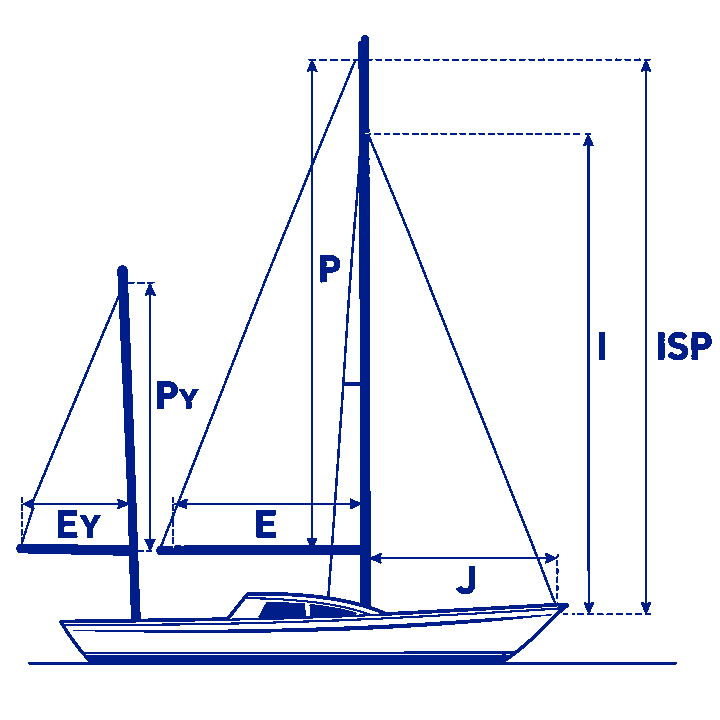
Rig dimension I (foretriangle height)
Rig dimension J (foretriangle base)
Rig dimension P (mainsail luff)
Rig dimension E (mainsail foot)
Mainsail area
362 sq ft
catalinayachts.com ↗Builder's rated mainsail area; applies to the published standard sail plan.
Motion comfort ratio (Brewer)
Engine, propulsion, systems
Original engine make
Yanmar
catalinayachts.com ↗Factory engine make in the September 2005 Mk II brochure. Engine models changed during production.
Original engine model
4JH4BE
catalinayachts.com ↗Yanmar model stated in the September 2005 builder brochure. Earlier Mk II production used other Yanmar 4JH-series engines.
Original engine power
54 hp
catalinayachts.com ↗Factory engine power in the September 2005 brochure. Another source gives 50 (www.practical-sailor.com: Practical Sailor describes a 50-hp Yanmar on earlier production. The discrepancy reflects an engine change during production, not a separate design mark.).
Fuel capacity
46 gal
catalinayachts.com ↗Standard fuel capacity in the 2005 builder brochure. An additional 17-gallon tank was optional, yielding 63 gallons when installed. The Catalina 4 Series Association also identifies the Mk II replacem
Fresh water capacity
111 gal
catalinayachts.com ↗Two-cabin layout. The same builder brochure states 131 gallons for the three-cabin layout. WaveTrain independently confirms both layout-dependent capacities; the layout difference is not a separate pr
Holding tank capacity
52 gal
vesselguide.net ↗Combined holding capacity. Catalina's 2005 brochure independently specifies a 30-gallon forward holding tank and a 22-gallon aft holding tank.
Accommodation
Cabins
2
catalinayachts.com ↗Two-cabin configuration. Three-cabin configurations were also factory-offered; the cabin count is a layout option, not a production mark.
Heads (count, enclosed or not)
Navigation station
Yes
catalinayachts.com ↗The builder's brochure describes a dedicated navigation work surface. The station's position varies with interior layout.
Practical ownership
Known issues (sourced to magazines / associations)
Reported osmotic hull blistering, including some post-1995 boats despite the vinylester barrier coat.
practical-sailor.com ↗Practical Sailor reports that fewer than 10% of surveyed owners reported blisters. Another source gives Potential water leaks around chainplate fasteners and moisture accumulation around deck penetrations. (www.tapatalk.com: Owners' association technical discussion; inspect bedding and the adjacent
Strengths (sourced)
Mk II: Deeper, higher-aspect rudder improves handling and reduces steering effort compared with the original rudder.
practical-sailor.com ↗ Solid-fiberglass hull with a substantial molded structural liner.
practical-sailor.com ↗Construction is described favorably relative to similarly priced production cruisers. Another source gives Roomy accommodations and practical choices between two- and three-cabin layouts. (www.spinsheet.com: The two-cabin layout has particularly useful galley and storage arrangements.).
Owners' association link
Https://www.catalina4series.org/
catalinayachts.com ↗Association listed on Catalina Yachts' official website. Its technical discussion forum includes Catalina 42 coverage.
Calculated from the figures above
Sail area / displacement ratio
17.02
Calculated: sail area divided by (displacement in lb / 64) to the power 2/3, using the published sail area and displacement above.
Pounds per inch of immersion (estimate)
1779.1
Estimated, not measured: waterline length x beam x 0.67 (typical waterplane coefficient) x 64 / 12, using the published figures above.