Catalina 350

Catalina Yachts

Catalina 350 is a 36.42 ft sloop sailboat built by Catalina Yachts and designed by Gerry Douglas, first produced in 2003. It has displacement of 12,937 lb, a hull speed of 7.49 kt and a fin (deep) and wing (shoal) keel.
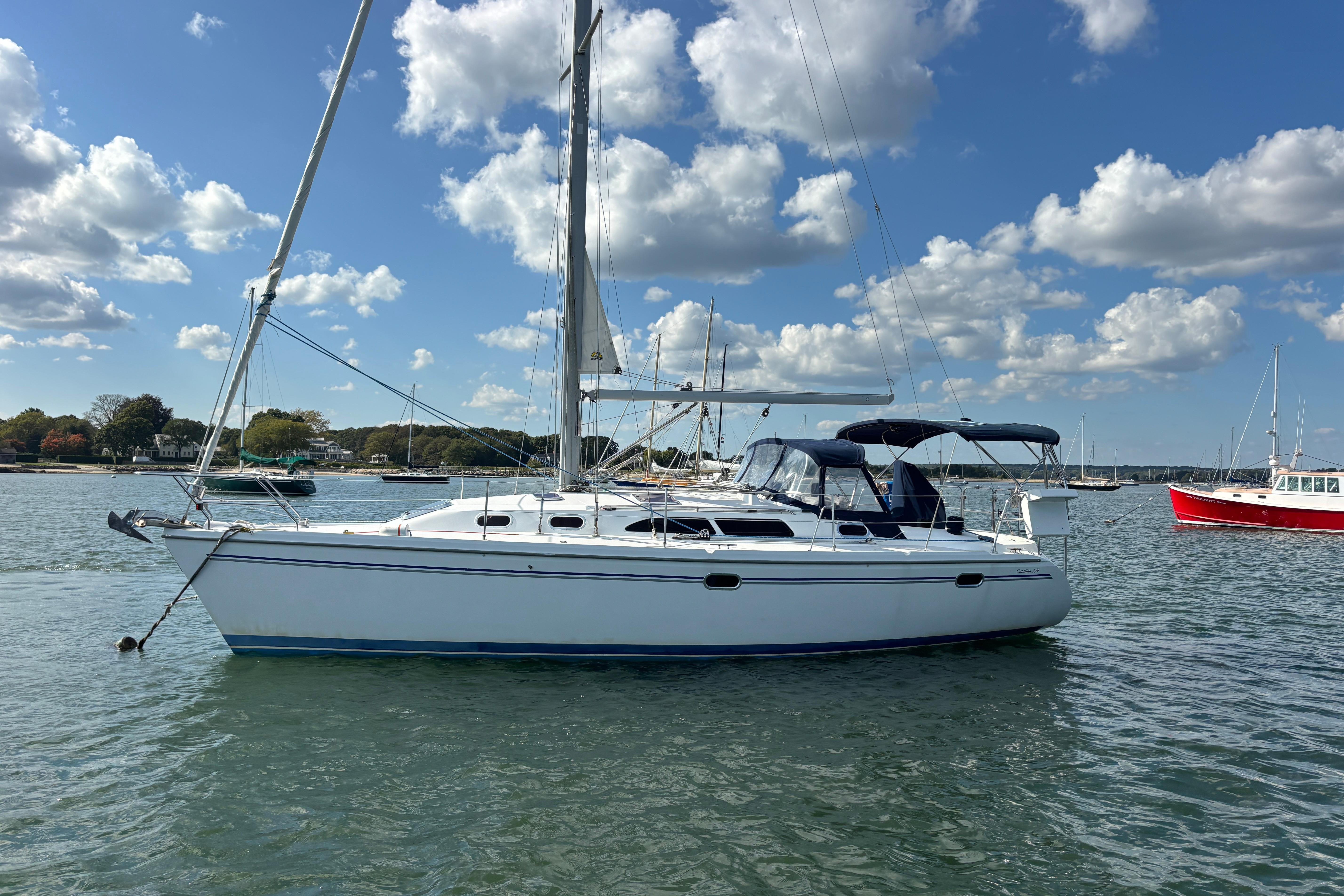
Catalina 350
Bluenose Yacht Sales / Global Yacht Exchange · Photo source
Community photos are ranked by votes.Add your photo

At a glance

Length
36.42 ft↗
Beam
13 ft↗
Draft
  • Standard keel6.67 ft
  • Wing keel4.5 ft
↗
Displacement
12,937 lb↗
Ballast
5,137 lb↗
Rig
Sloop↗
Built
2003–2010
Hull speed
7.49 kt
Headroom
6.75 ft↗

The quick verdict

The Catalina 350 is an excellent choice for couples or families who prioritize comfortable coastal cruising, easy handling and generous living space. Its standout strength is an exceptionally spacious interior with two private cabins, substantial headroom and a separate shower. Its broad hull and shallow wing-keel option favor cruising comfort over maximum upwind performance. Buyers should inspect keel-joint condition, deck hardware, windlass seals, fuel-tank welds and the rig, while checking the engine and keel configuration against the boat's production year.

Shopping for a boat like this?

Tell us how you'll sail and who's coming along. The Boat Picker asks a few quick questions and shows which boats fit your plans, so you can skip the guesswork.

Try the Boat Picker

All specifications

Production years
2003–2010
Designer
Gerry Douglas↗

Dimensions & rating

Length overall
36.42 ft↗
Beam
13 ft↗
PHRF
141 (132–147)↗
Displacement
12,937 lb↗
Hull speed
7.49 kt
Standing headroom
6.75 ft↗
Draft by configuration↗
Standard keel6.67 ft
Wing keel4.5 ft
Rudder type
Spade
Twin wheels
No↗
Rig type
Sloop↗
Mast step
Deck-stepped↗

Standardized sailing characteristics

Speed

PHRF 141

Lower PHRF means a faster racing handicap. Published configurations: 132–147. Rig, keel, and region affect ratings.

Reference source ↗

Comfort at Sea

Catalina 22 Mk IIPrecision 28Oceanis 37Catalina 30Island Packet 38Oyster 53
20.22

This boat's motion comfort ratio: a comparison of how gently a design moves at sea. A higher number is gentler. It does not rate cabin space or guarantee comfort.

Capsize screening (CSF)

Catalina 22 Mk IIPrecision 28Oceanis 37Catalina 30Island Packet 38Oyster 53
CSF 2.22

The Capsize Screening Formula: beam compared with displacement. A lower number means a boat is less prone to capsize, so the scale runs from least to most capable offshore; 2.0 or below is the usual guide. It is a screening figure, not a safety guarantee.

Measurements

Rig diagram & sailing measurements

Rig dimension reference
Rig measurement diagram showing I, ISP, J, P, E, PY and EY
General rig reference. PY and EY apply to boats with a mizzen mast.
CSF2.22
Above 2.0: generally does not meet the traditional offshore screening guideline (not a seaworthiness rating).
Rig dimension I (foretriangle height)46.75 ft↗
Rig dimension J (foretriangle base)14.42 ft↗
Rig dimension P (mainsail luff)40.92 ft↗
Rig dimension E (mainsail foot)13.5 ft↗
Forestay lengthMk II: 46.63 ft / 48.92 ft↗
Sail area (base / working)613 sq ft↗
Mainsail area276 sq ft↗
Headsail / genoa area337.1 sq ft↗
Spinnaker / gennaker area1,012 sq ft↗
Air draft (clearance height)52 ft↗
Ballast / displacement ratio39.7
Hull speed7.49 kt

Construction

Construction

Hull material
Fiberglass ↗
Hull cored below waterline
No ↗
Hull cored above waterline
No ↗
Hull core material
None ↗
Deck cored
Yes ↗
Deck core material
Balsa ↗
Hull-to-deck joint
Shoebox ↗
Structural grid / pan liner
Bonded fiberglass structural grid and interior liner ↗
Keel type
Fin (deep) and wing (shoal) ↗
Keel material
Lead ↗
Keel attachment
Bolted ↗
Rudder type
Spade
Number of rudders
1
Steering type
Wheel ↗
Twin wheels
No ↗
Fuel tank material
Aluminium ↗

Construction & Equipment

Tankage

Fuel capacity
39 gal ↗
Factory fuel capacity, consistent across the original manual, MkII brochure and Catalina Direct's model-specific replacement tank.
Fresh water capacity
88.5 gal ↗
Important distinction: Catalina's quoted total includes an 11-gallon hot-water heater. The two primary freshwater tanks are 55 and 22.5 gallons, totaling 77.5 gallons of tank storage.
Holding tank capacity
22 gal ↗
Catalina's published capacity in both generations. Owners report measured usable capacities of approximately 15 to 20 gallons on some boats, possibly due to plumbing configuration, installation differences or incomplete emptying.

Accommodation

Headroom (saloon)
6.75 ft ↗
Six feet nine inches in the saloon, independently corroborated by SAILING Magazine. Canadian Boating quotes 2.11 metres, approximately 6 feet 11 inches, so published interior measurements are not fully consistent.

Production history

Mk I

2003–2007

Mk II

2007–2010
  • A redesigned deck introduced a lower cabin top and larger windows while retaining the original hull.
  • A new Selden mast, boom and vang replaced the earlier spar arrangement without changing the rated sail area.
  • A redesigned transom removed the waterline joint and introduced a folding stern ladder deployable from the water.
  • The cockpit gained updated pedestal steering, more comfortable stern rail seats and port-side traveler controls.
  • The galley gained solid-surface counters and a splash guard, while better refrigeration insulation improved efficiency.
  • Revised freshwater plumbing, cabinetry, saloon table and navigation area improved access, storage and usability.

Full specifications

Figures link to the page they came from where one is published. Anything not shown is not yet confirmed by a published source.

Identity

Designer
Gerry Douglas practical-sailor.com ↗
Both marks share the same Gerry Douglas hull design.
First year built
2003
Last year built
Mk I: 2007 catalinayachts.com ↗
The MkII replaced the original generation in 2007. The precise last MkI hull completion date was not independently established.
Mk II: 2010 catalina350.com ↗
An association member reports ordering a Catalina 350 in 2010 and believes it was the final boat built. This documents production as late as 2010 but is not an official manufacturer confirmation of the final production year.
Country built
United States practical-sailor.com ↗
Manufactured by Catalina Yachts in Florida.
Boat type
Sailing monohull sailcentral.com ↗
Single-hulled sailing cruiser.
Hull type
Monohull

Hull measurements

Length overall
36.42 ft catalina350.com ↗
Factory overall length, 36 feet 5 inches. The same measurement appears in the MkII brochure. These differences should not be interpreted as a redesigned hull.
Length on deck
35.25 ft catalina350.com ↗
Factory hull length, separate from the 36-foot-5-inch overall length. The MkII retained the same hull.
Waterline length
31.27 ft
Beam (widest)
13 ft catalina350.com ↗
Confirmed by the factory MkII brochure and independent reviews.
Draft (standard keel)
6.67 ft catalina350.com ↗
Fin keel. Catalina's deep-draft option, specified for both marks. The wing keel is recorded separately under draft_alt_1. The original 2003 manual and 2008 MkII brochure confirm the 6-foot-8-inch measurement.
Draft (alternate keel 1)
4.5 ft catalina350.com ↗
Wing keel. Factory shallow-draft option on both the original Catalina 350 and the MkII. Its specified ballast is 6,212 pounds and design displacement 14,012 pounds.
Air draft (clearance height)
52 ft catalina350.com ↗
Factory masthead height above the waterline. This does not necessarily include masthead antennas, wind instruments or other equipment.
Hull speed
7.49 kt
Calculated: 1.34 x the square root of the waterline length (31.27 ft).
Displacement (light / design)
12,937 lb catalina350.com ↗
Fin keel. Catalina's later factory design displacement. The original 2003 manual and the MkII brochure give this figure. Early 2002 literature and magazine reviews instead report 13,635 pounds. Wing keel: 14012. Conflicting earlier published figure: 13635.
Ballast weight
5,137 lb catalina350.com ↗
Fin keel. The later factory specification, confirmed by the MkII brochure. Wing keel: 6212. Other published figure: 5835.
Ballast material
Lead catalina4series.org ↗
A Catalina 350 owner describes the factory keel as antimony-alloyed lead. Owners' association discussions independently refer to the model's lead keel.
Ballast / displacement ratio
39.7
Calculated: ballast divided by displacement, using the published figures on this page.

Rig and sails

Rig type
Sloop mauripro.com ↗
Masthead sloop with a single mast, forestay and split backstay. Robert Perry's SAILING review independently identifies the masthead rig.
Rig options offered
Conventional mainsail with Dutchman flaking; optional in-mast furling sailingmagazine.net ↗
The review also states the model was available with a full-batten mainsail and Dutchman flaking system. The MkII introduced an updated Selden rig while retaining the same basic masthead sail plan.
Number of masts
1 mauripro.com ↗
Single-masted masthead sloop.
Mast material
Mk I: Aluminium manualzz.com ↗
The original Catalina 350 owner's manual explicitly identifies an aluminum mast. The MkII uses a different Selden-supplied mast; a separate model-specific material statement was not confirmed.
Mast stepping
Deck-stepped catalinadirect.com ↗
Catalina Direct explicitly documents deck-stepped Catalina 350 furling masts. SAILING Magazine independently describes a mast compression post below the deck. The exact step fitting changed during production.
Sail area (base / working)
613 sq ft catalina350.com ↗
The adjoining factory specification gives 613 square feet. This is the working sail area using the 100-percent foretriangle, not the 731-square-foot mainsail-plus-135-percent-genoa combination. The owners' manual confirms 613 square feet.
Rig dimension I (foretriangle height)
46.75 ft catalina350.com ↗
Factory foretriangle height. Confirmed by Point Sails' Catalina 350 rig dimensions.
Rig dimension J (foretriangle base)
14.42 ft catalina350.com ↗
Factory foretriangle base.
Rig dimension P (mainsail luff)
40.92 ft catalina350.com ↗
Factory mainsail luff dimension.
Rig dimension E (mainsail foot)
13.5 ft catalina350.com ↗
Factory mainsail foot dimension.
Spinnaker / gennaker area
1,012 sq ft pointsails.com ↗
Running asymmetrical spinnaker offered by Point Sails specifically for the Catalina 350. This is a sailmaker's aftermarket offering, not a documented Catalina factory-standard sail.
Forestay length
Mk II: 46.63 ft catalina350.com ↗
Manufacturer-stated standing-rigging forestay wire length in the rigging table, 46 feet 7.5 inches. Early MkI forestay lengths and fittings differed.
48.92 ft
Calculated: the square root of (I squared + J squared), using the published rig dimensions on this page.
Headsail / genoa area
337.1 sq ft mauripro.com ↗
100-percent foretriangle headsail. Catalina separately specifies a standard 135-percent genoa in its manual. The 337.1-square-foot figure is a published sail-area specification, not a claim that all boats carried this particular headsail.
Mainsail area
276 sq ft catalina350.com ↗
Factory-rated conventional mainsail area. In-mast furling versions, particularly with unbattened mainsails, can have less actual cloth area.
Displacement / Length ratio
188.9
Calculated: (displacement in long tons) divided by (0.01 x waterline length) cubed, using the published figures on this page.
Capsize screening value
2.22
Motion comfort ratio (Brewer)
20.22

Engine, propulsion, systems

Original engine make
Mk I: Universal practical-sailor.com ↗
Original standard MkI engine. A Catalina 350 owner also reports a factory special-order Yanmar installation in 2006, so Universal was not necessarily fitted to every MkI hull.
Mk II: Yanmar catalina350.com ↗
Factory MkII brochure specifies a three-cylinder, 30-horsepower Yanmar. The MkII manual contains an earlier, reused specifications page naming the Universal M-35B; the later MkII brochure is preferred for this production generation.
Original engine model
Mk I: M-35B catalina350.com ↗
Original standard engine, verified against the original 2003 owner-manual specifications. The quoted page appears in the MkII manual as a reused specification revision dated December 2005, not proof that all MkII boats had Universal engines.
Mk II: 3YM30 catalina350.com ↗
A MkII owner explicitly identifies a factory-installed Yanmar 3YM30. The MkII brochure independently identifies a three-cylinder, 30-horsepower Yanmar as standard, although it does not print the 3YM30 model designation.
Fuel capacity
39 gal catalina350.com ↗
Factory fuel capacity, consistent across the original manual, MkII brochure and Catalina Direct's model-specific replacement tank.
Original engine power
Mk I: 35 hp catalina350.com ↗
Factory-rated Universal M-35B engine in the original Catalina 350.
Mk II: 30 hp catalina350.com ↗
The adjoining builder specification states Yanmar, three cylinders and 30 HP. This replaces the original 35-horsepower Universal specification.
Fresh water capacity
88.5 gal catalina350.com ↗
Important distinction: Catalina's quoted total includes an 11-gallon hot-water heater. The two primary freshwater tanks are 55 and 22.5 gallons, totaling 77.5 gallons of tank storage.
Holding tank capacity
22 gal catalina350.com ↗
Catalina's published capacity in both generations. Owners report measured usable capacities of approximately 15 to 20 gallons on some boats, possibly due to plumbing configuration, installation differences or incomplete emptying.

Accommodation

Cabins
2 sailingmagazine.net ↗
Two separate sleeping cabins, forward and aft. The MkII brochure describes the same two-cabin interior arrangement.
Heads (count, enclosed or not)
1 sailingmagazine.net ↗
One enclosed head with a separate shower stall. The independent review and factory accommodation descriptions identify a single head compartment.
Navigation station
Yes practical-sailor.com ↗
Dedicated chart/navigation work area, with an aft-facing chart table. The MkII redesigned the navigation area to accommodate more electronics.
Headroom (saloon)
6.75 ft practical-sailor.com ↗
Six feet nine inches in the saloon, independently corroborated by SAILING Magazine. Canadian Boating quotes 2.11 metres, approximately 6 feet 11 inches, so published interior measurements are not fully consistent.

Practical ownership

Known issues (sourced to magazines / associations)
Shallow bilge; reduced performance with unbattened in-mast furling mainsail; potential corrosion of threaded deck-hardware plates; occasional windlass-seal leaks, aluminum fuel-tank seam leaks and keel-to-hull joint cracking. Early Universal M-35B installations also warrant inspection for the fuel-filter bracket service bulletin. practical-sailor.com ↗
Practical Sailor documents the shallow bilge, threaded deck-plate concerns and limited sailing performance with an unbattened furling main. Catalina 350 association discussions document reported windlass, tank and keel-joint issues.
Strengths (sourced)
Exceptionally spacious two-cabin interior, 6-foot-9-inch saloon headroom, generous cockpit, wide side decks, separate shower, manageable sail controls and comfortable handling. The shoal wing-keel option increases access to shallow cruising grounds. sailingmagazine.net ↗
SAILING and Canadian Boating report enjoyable handling; Practical Sailor highlights interior volume and an easy-to-use layout, while reporting slower performance in light air with an unbattened furling mainsail.
Owners' association link
catalina350.com catalina350.com ↗
Dedicated association with technical documentation, factory manuals, owner-maintenance articles and active discussion forums for both marks.

Calculated from the figures above

Sail area / displacement ratio
17.8
Calculated: sail area divided by (displacement in lb / 64) to the power 2/3, using the published sail area and displacement above.
Pounds per inch of immersion (estimate)
1452.6
Estimated, not measured: waterline length x beam x 0.67 (typical waterplane coefficient) x 64 / 12, using the published figures above.

Catalina 350 problems

Reported by owners and reviewers. Condition varies from boat to boat.

  • Shallow bilge ↗
  • Reduced performance with unbattened in-mast furling mainsail ↗
  • Potential corrosion of threaded deck-hardware plates ↗
  • Occasional windlass-seal leaks, aluminum fuel-tank seam leaks and keel-to-hull joint cracking. Early Universal M-35B installations also warrant inspection for the fuel-filter bracket service bulletin ↗
  • Association members report that some Catalina 350s develop a visible keel-to-hull joint crack, commonly called the Catalina Smile, and discuss manufacturer keel-bolt torque guidance. ↗
  • Several owners measured less usable holding-tank capacity than the advertised 22 gallons, with some reporting approximately 18 to 20 gallons. ↗
  • Owners investigating forward-cabin leaks report that failed electric anchor-windlass seals can imitate a leaking hull-to-deck joint. ↗
  • One owner discovered an aluminum fuel-tank seam leak after removing the original tank, confirming a maintenance concern for aging examples. ↗

What the magazines say

Owner experiences and professional commentary are separate sources. Condition varies from boat to boat.

  • Practical Sailor praised the Catalina 350's spacious accommodations but experienced disappointing light-air speed with the unbattened in-mast furling mainsail. Read source
  • SAILING Magazine found the Catalina 350 surprisingly nimble, with a balanced helm, expansive cockpit and unusually generous accommodation for its length. Read source
  • Canadian Boating reported responsive sailing and approximately six knots upwind in twelve knots of wind, highlighting the comfortable cruising layout. Read source
  • Naval architect Robert Perry appreciated the wide side decks and spacious cockpit but questioned the unusually broad proportions and mid-boom mainsheet location. Read source

Catalina 350 documents

Links to the builder's and other published documents.

What's on file

  • 1survey
  • 0upgrades
  • 0maintenance items

Surveys and Market Value

2004 boat · Survey 2026 · Valued at $79,000 (USD)

Overall condition: Average

Average condition; requires some usual maintenance and repairs, typically equipped for its size.

Valued at $79,000 (USD) · Replacement $350,000

Problem spots found

  • Forward salon bulkhead has separated about 3/8 in from the deck, possibly from over-tightened rigging
  • Mast head leans to starboard; standing rigging needs tuning and proper tightening
  • Engine raw water vented loop is leaking and needs replacing
  • Engine raw water intake hose is cracked and degraded
  • Raw water pump shows signs of leaking
  • Dripless drive shaft seal leaked during survey and trial run
  • Starboard aft engine mount worn; port aft mount corroded
  • Corrosion on some keel bolts
  • Elevated moisture (reading 100) with normal sounding on port foredeck; monitor
  • Air conditioner discharge through-hull above waterline is damaged
  • Engine starting battery terminals heavily corroded; battery age unknown
  • Wire nuts on cabin fans and AC/DC wiring not separated behind the panel; no ELCI breakers
Up to 2 per boat, PDF under 4 MB (larger ones: add them from My boats). This can take up to a minute.

Watch the boat

Is This the Best 35-Foot Sailboat Ever Made? Catalina 350

Watch on YouTube ↗

Community contributions or corrections

Do you have information about this boat, a photo of it, or advice for future owners? Leave a comment below regarding this make and model. For corrections, leave the corrected information with the source so we can investigate and update the boat wiki page.

Sign in

Comments

No comments yet.