Catalina 30
Catalina Yachts · Designed by Frank Butler · 1975–2008

- Draft
- 3' 10" to 5' 3"
- Length overall
- 29' 11"
- Beam
- 10' 10"
- Displacement
- 10,200 lb
- Number built
- Approx. 6,450
- Waterline length
- 25'
- Ballast
- 4,200 lb
- Advertised sail area
- 446 ft²
- Air draft
- 45' 11" to 47' 11"
- Hull construction
- Fiberglass
Keel and rig choices can change individual measurements.
Manufacturer/source specification ↗Speed
Lower PHRF means a faster racing handicap. Published configurations: 171–192. Rig, keel, and region affect ratings.
Reference source ↗Comfort at Sea
Raw Brewer Motion Comfort Ratio, a comparison of design motion at sea. It does not rate cabin space or guarantee comfort.
Bluewater Capability
The actual published Blue Water Value for the documented design or variant, not a seaworthiness certification.
Reference source ↗Keel and draft options
Draft matters when choosing a slip, cruising shallow water, or planning a haulout.
Sailing ratios
Calculated from the representative published dimensions and displacement, not measurements of a particular hull.
Construction & Equipment
Hull & Deck
- Hull below waterline
- Solid fiberglass (uncored) ↗
- Hull above waterline
- Solid fiberglass (uncored) ↗
- Deck construction
- Fiberglass sandwich laminate ↗
- Deck core
- Balsa / plywood ↗
- Interior hull liner
- Molded fiberglass liner ↗
- Hull-to-deck joint
- Overlapping shoebox joint · bonded · mechanically fastened · stainless fasteners ↗
- Keel construction
- Externally bolted lead ↗
- Bulkheads
- Plywood ↗
Rig & Steering
- Sail plan
- Masthead sloop ↗
- Rig options
- Standard rig · Standard rig + bowsprit · Tall rig · Tall rig + bowsprit ↗
- Mast
- Aluminum · deck-stepped ↗
- Mast support
- Compression post ↗
- Steering
- Mark I: tiller · Mark II: wheel · Mark III: wheel ↗
- Cockpit evolution
- Mark I: straight cockpit · Mark II: T-shaped cockpit · Mark III: walk-through transom ↗
Engines & Tankage
Accommodation
Production history
Mark I
- Original straight cockpit, designed for tiller steering and end-boom mainsheet controls.
- Later Mark I boats received factory improvements, including wheel-steering options and changes to mainsheet and rudder arrangements.
Mark II
- Redesigned T-shaped cockpit with wider coamings, intended for pedestal wheel steering.
- Halyards were routed inside the mast and led back to the cockpit. The wing-keel option was introduced during this generation.
Mark III
- Wider stern with a walk-through transom, swim/boarding platform and additional cockpit seating.
- An expanded galley and extra storage improved life below decks. The wing keel became standard.
Accommodation layout
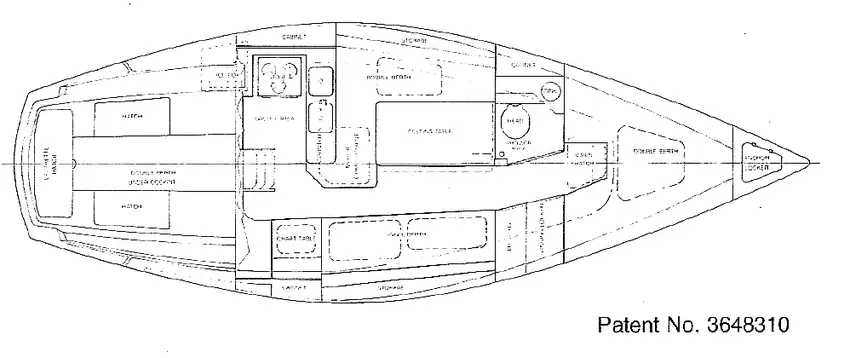
Drawing: Catalina Yachts · Original source ↗
Owner experience & independent reviews
Owner experiences and professional commentary are separate sources. Condition varies from boat to boat.
What owners report
- Mast-step depression and deterioration of the compression support or bilge block are recurring owner repair topics. Read source
- Owners report water leaks around deck fittings and chainplates; check for damp bulkheads and wet core. Read source
What the magazines say
- Practical Sailor praises the room and cruising value, while noting mast-step depression, chainplate reinforcement on early boats, and other age-related inspection points. Read source
- SpinSheet sees a practical, roomy family cruiser, with survey attention warranted for deck cores, mast support, older chainplates and keel-joint leaks. Read source
Surveys & Known Issues
No surveys have been contributed for this boat yet.
Help fellow sailors, owners, and buyers make better decisions about this boat. Share a marine survey to help us identify recurring issues, understand boat condition, and build a picture of surveyor-estimated values over time.
Your privacy matters. We'll remove names, locations, contact details, vessel identifiers, and other personal information before any findings are shared. Only anonymized insights appear on Boat Wiki. Your original survey will never be published.
Watch the boat
Lady K Sailing: Perfect $20,000 Sailboat, Catalina 30 Refit on a Budget, Episode 358
Sources and further reading
Original research references. Check the exact model year and configuration when comparing boats.
- Catalina 30 factory brochure
- Catalina 30 original factory owners manual (undated early edition)
- Catalina 30 Association Bylaws
- Catalina 30 One Design Class Specifications
- Catalina 30 Mk III published BWV
- Catalina 30 specifications, representative original equipment
- Catalina 30 Association FAQs
- Catalina 30 Practical Sailor review
- Catalina 30 Review by Jack Hornor
- Catalina 30/309 model history
- Catalina Direct C-30 dinette cushion layout
- Catalina Direct C-30 Dinette Interior technical PDF
- Catalina Direct C-30 Mark II / Mark III rudder
- PHRF of Narragansett Bay - Base Handicaps, Catalina 30 class entries
- The Original Sailing Mini-Van
Specifications describe a model, not the condition or equipment of an individual boat. Verify dimensions and have any purchase professionally surveyed.