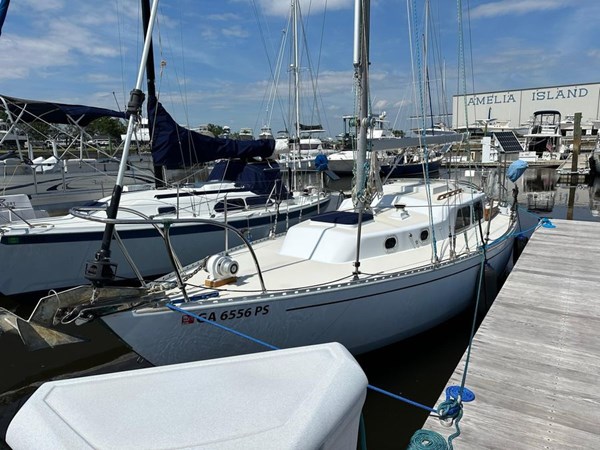
Alberg 30
Whitby Boat Works Ltd.
- Production years
- 1962–1984
- Total built
- 700
- Designer
- Carl Alberg
Dimensions & rating
- LOA
- 30' 3"
- Beam
- 8' 9"
- PHRF
- 220↗
- Displacement
- 9,000 lb
The quick verdict
The Alberg 30 is a classic full-keel cruiser that reviewers call well built and seaworthy, backed by an active owner association. Expect a narrow, dated interior and a boat that heels hard under sail. Have a survey check the chainplates, engine and stuffing box before buying.
Well built and seaworthy; Rugged construction for its size; Traditional, pleasing appearance; Easy to sail with balanced sail plan; Very active owner association
About 20-25% less interior space than modern 30-footers; Tender boat that sails at a high angle of heel; Dated layout: settee berths, jammed head, split galley; Original Gray/Bukh engines short of power and parts; Tender, heels sharply under sail until reefed early; Narrow, cramped interior for a 30-footer; Chainplate fillet weak spot; owners reinforce it; Stuffing box packing is hard to service
Find out whether this design suits your sailing plans with The Boat Picker.
Standardized sailing characteristics
Speed
Lower PHRF means a faster racing handicap. Rig, keel, and region affect ratings.
Reference source ↗Comfort at Sea
Raw Brewer Motion Comfort Ratio, a comparison of design motion at sea. It does not rate cabin space or guarantee comfort.
Measurements
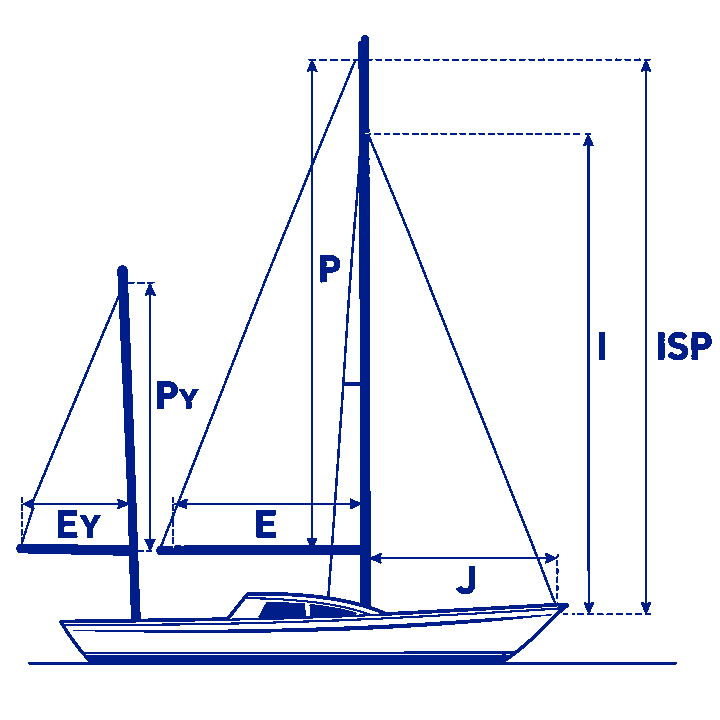
Rig diagram & sailing measurements
| SA/D · SAIL AREA TO DISPLACEMENT | 15.16 Below 16 is considered conservative sail power, 16–20 moderate sail power, and above 20 high sail power. |
|---|---|
| D/L · DISPLACEMENT TO LENGTH | 395 |
| S-NUMBER | 1.06 Calculated from SA/D and D/L (Brewer) |
| CSF | 1.68 Below 2.0: generally meets the traditional offshore screening guideline (not a seaworthiness rating). |
| Ballast/displacement | 36.7% ↗ Below roughly 30% can suggest a more tender boat, around 35% is common for cruisers, and 40% or more can suggest greater resistance to heeling. Keel depth, ballast placement, and hull shape also matter. |
| Theoretical hull speed | 6.23 kn ↗ |
| Waterline length | 21' 8" |
| Ballast | 3,300 lb |
| Advertised sail area | 410 ft²↗ |
| Foretriangle area | 193.5 ft² ↗ |
| Mainsail triangle | 220.88 ft² ↗ |
| Estimated forestay (published standard rig) | 37.57 ft ↗ |
Rig dimensions by configuration
| Published model reference | I | J | P | E | 100% triangular sail area |
|---|---|---|---|---|---|
| Published rig | 36′ | 10′9″ | 31′ | 14′3″ | 414.4 ft² |
100% triangular sail area = (I × J + P × E) / 2. Source ↗
Construction & Equipment
Production history
Number built: 700
Original
- Carl Alberg designed for lead ballast, but Kurt Hansen switched to cast iron to hold down production costs.
- Hulls before #27 had underweight ballast, and the association rules allow up to 460 lb of added internal ballast on those boats.
- After the molds were made, owners asked for a masthead rig, so the mast was shortened and the jib stay raised.
- Early models used a Gray Sea Scout auxiliary engine before the Universal Atomic 4 gas engine became the standard choice.
- Published figures: length overall 30.25 ft, waterline 21.67 ft, beam 8.75 ft, draft 4.25 ft, displacement 9,000 lb, ballast 3,300 lb, sail area 410 sq ft.
- Sources disagree: Wikipedia gives a 4.29 ft draft for the standard keel; the association FAQ gives 4' 3" (4.25 ft), which is the figure used here.
- Sources disagree: PHRF New England lists a base of 228, PHRF of the Chesapeake lists 231, and listingsport.com gives an average of 220.
- Sources disagree: Canadian Boating says the last hull was launched in 1983, while listingsport.com and keelindex.com give production as running to 1987.
Full specifications
Every figure links to the page it came from. Anything not shown is not yet confirmed by a published source.
Identity
Hull measurements
Construction
Rig and sails
Engine, propulsion, systems
Accommodation
Practical ownership
Calculated from the figures above
Surveys and Market Value
No surveys have been contributed for this boat yet.
When owners contribute surveys, we plan to share anonymized recurring issues and used-boat value ranges, helping future buyers know what to inspect and what similar boats are worth. Survey uploads are coming soon.
Your privacy matters.
We plan to remove names, contact details, precise locations and vessel identifiers before sharing aggregated findings and value ranges. Individual survey documents will not be published.
Community contributions
Sign in
Comments
No comments yet.